Bambanani – creating a better future for children through education

Afrika Tikkun Bambanani is the coming together of Afrika Tikkun and Bambanani Sifunde to form a group of ECD Specialists who implement a standardised ECD curriculum in rural underprivileged schools.

Johannesburg, Thursday 20 April 2023 – At the launch of the BambaLearn App by Afrika Tikkun Bambanani (ATB)last night, expert insights were shared around the upskilling and training of teachers required to assess and monitor learner development. Simultaneously the programme is designed to facilitate teacher progression equipping them to screen for learning difficulties and arrange intervention, provide psychosocial support and monitor child growth and progress. The BambaLearn App aims to extend children on the curriculum ensuring that no child is left behind.

“The period from birth to six years old is the most vital stage of brain development for children and these informative years represent a crucial window of opportunity for education. The ATB programme is developed to ensure early childhood care and education that is truly inclusive. It is much more than just preparation for Grade 1, ECD is the foundation for emotional wellbeing and learning throughout life; and is one of the best investments a country can make as it promotes holistic development, gender equality and social cohesion,” shared the passionate ATB programme CEO, Theresa Michael.

Afrika Tikkun Bambanani’s Mission & Vision

To reach as many children as possible aged birth to six years of age across all rural and underprivileged communities of SA and to provide play-based learning through trained ECD teachers who will build a solid foundation for their education and overall wellbeing. The long-term vision is to standardise the ECD curriculum throughout SA to ensure that no child is left behind in terms of education which will lead to equal opportunity for all children in SA.

Afrika Tikkun Bambanani’s Impact

Currently 800 upskilled practitioners working in 200 Early Learning Centres in disadvantaged communities and underprivileged rural areas are providing a solid foundation for 10 000 children through this initiative.

ATB aims to provide a safe, nurturing and stimulating environment for South African children and invest in their education by providing them with the tools they need to succeed. Early childhood education has a positive impact on our society as a whole; helping reduce poverty, promote economic growth, and decrease the likelihood of negative social outcomes such as crime and substance abuse.

What does Afrika Tikkun Bambanani offer?

  • ECD Curriculum age 0-6 years
  • Teacher training
  • Resource kits
  • Data-free online assessment centre to monitor student and teacher progression
  • Data-free online screening tool assessment for children
  • In-class teacher training and mentorship
  • The BambaLearn App for children from 2-6 years old

How does Afrika Tikkun Bambanani work?

The three-year ECD programme is presented as a customised ATB package to suit the needs of each centre/community. It includes a five-day teacher pre-training programme, monthly up-skill teacher training, online curriculum, printed manuals and workbooks, online assessment centre and in-class mentorship.

Registered as part of the Afrika Tikkun brand, the ATB training, assessment and curriculum programme has brought together a team of ECD practitioners, theorists, educators, investors and therapists to create the best ECD curriculum available in South Africa and make it available to ECD practitioners and children living in under-resourced communities around South Africa. The programme readily collaborates with government and private sectors.

Early Childhood Development (ECD) is the period spanning from birth until the year before a child enters formal schooling. Research shows that children who do not have access to adequate ECD are more likely to struggle academically and have lower earning potential as adults, and they are also more likely to engage in risky behaviours, such as substance abuse or criminal activity. Furthermore, the effects of inadequate ECD can have an intergenerational impact on children, in that they are likely to struggle as parents themselves, trapped in a perpetuated cycle of poverty.

Sadly, the highest failure rate in South African schools occurs in Grade 1. Investing in ECD can lead to better school readiness, improved academic achievement, higher earning potential, and better health outcomes in adulthood. Additionally, a nurturing and supportive early childhood environment can promote positive social-emotional skills and behaviours, which can lead to stronger relationships and increased well-being throughout life.

We can change the trajectory of many young children currently at risk if we equip ECD practitioners with the skills needed to deliver quality early learning programmes that meet children’s developmental needs.

Many ECD centres in under-resourced communities are not able to employ qualified practitioners, and although a lot of their staff do have years of working experience, they do not have the formal training to design outcomes-based programmes. To support these centres, we have developed an innovative and comprehensive ECD curriculum that is designed to meet the developmental needs of children aged one to six years, which can be implemented by ECD practitioners who have little or no formal ECD training.

The key activities to support participating ECD centres to implement a quality ECD programme include:

  • Developing an outcomes-based ECD curriculum that provides the framework for children aged one to six years to meet their developmental milestones and equip them with the skills needed for future academic success.
  • Providing the ATB curriculum to participating centres in the form of printed manuals, workbooks, theme posters and assessment portfolio files. An online version of the curriculum is also available.
  • Offering off-site training to ECD practitioners and principals up-skilling them to implement the ATB curriculum, as well as outcomes and teaching methods.
  • Providing in-classroom training and mentoring for the first three years of implementation.
  • Monitoring and assessing practitioner progress through online teacher progression assessments and monthly tasks they are required to upload. Any gaps identified will be addressed by our trainers through offering additional training sessions, as well as on-site implementation support.
  • Using tracking sheets to assess the termly progress of all children aged one to six years who are in the programme.
  • Providing the schools with screening assessments tools for children aged six months to six years.
  • Providing ongoing support through site visits from year 1, and into year 3.

These activities are supported by two innovative technologies, thereby removing geographical limitations as any ECD centre with internet can access the programme.

1.           Learner Tablet App – BambaLearn (Data Free)

BambaLearn is an app that allows young children to develop their critical thinking and to reach their milestones through play. Created by experts, designed for (and loved by) children ages 2-6 years, this app ensures that age-appropriate milestones are reached through rigorous performance monitoring through games. These include a wide variety of educational puzzles, story books, numeracy activities, problem solving games, literacy, shapes, tracing, counting, letter and number recognition. This app ensures that no child is left behind by enabling stronger learners to work ahead and providing extra revision and repetition for weaker learners.

2.           Afrika Tikkun Bambanani Assessment Centre (Data Free)

The goal is to improve and standardise the ECD content in our nation’s ECD centres, empowering practitioners to spend more time with the children. The ATB assessment centre ensures that no child or teacher is left behind. ATB provides tracking sheets and termly reports to monitor learner progression, focusing on critical developmental milestones, screening tools to red-flag learners that require intervention, and practitioner tracking and evaluating.

A state-of-the-art remote upload portal allows us to assist and observe our learners and teachers, especially schools in remote areas. ATB’s online trainers assess and report on all activities and video tasks assigned to the practitioner for the week.

The potential of millions of young children is lost due to our inability to provide families living in marginalised communities access to quality early childhood education programmes. ATB’s vision is to uplift the lives of our children and improve the quality of ECD teaching in South African to reach remote and disadvantaged communities and ECD centres with the knowledge and resources needed to implement an effective ECD curriculum, changing the trajectory of thousands of young beneficiaries of this programme.

What makes Afrika Tikkun Bambanani different is their approach to sustainability. The Sustainable Development Goals (SDGs) and Environmental, Social, and Governance (ESG) goals aim to promote sustainable and responsible practices, with the SDGs addressing a wider range of development issues on a global scale, and ESG goals focusing on the environmental, social, and governance factors of companies and organizations. The underlying value of the ATB programme is to “leave no child behind”, and in so doing supports several SDGs, including:

  • SDG 1 (No Poverty): Effective ECD programmes can break the cycle of poverty by improving children’s development, health, and learning outcomes, which ultimately leads to better employment opportunities and higher incomes in adulthood.
  • SDG 4 (Quality Education): This ECD programme has been designed to prepare children for school and lifelong learning by providing high-quality early learning experiences, such as language and literacy development, social-emotional skills, and critical thinking.
  • SDG 5 (Gender Equality): As inclusivity is one of ATB’s priorities, the programme aims to address gender inequality by providing equal opportunities for boys and girls to learn and develop, addressing gender stereotypes, and empowering parents to support their children’s education.
  • SDG 10 (Reduced Inequalities): This programme can be adapted to include all children, including those living with disabilities, and has been designed to be relevant to all children, including those from poor households, in the spirit of “leave no child behind”.

ATB are looking at how to link their centres to their health and psychosocial programme, which focuses on nutrition, psychosocial intervention, eye screening and audio screening, Once this is included, ATB will also be supporting SDG 3 (Good Health and Wellbeing).

Afrika Tikkun Bambabani Curriculum Overview:

Play-Based Learning

A play-based programme which nurtures vital life skills including social, emotional and cognitive development. This enhances the whole child by providing the self-confidence required to explore new environments and experiences.

Broad-Based Curriculum

A curriculum based on an eclectic education system which combines knowledge from multiple disciplines and educational theorists that is developmentally appropriate. The approach encourages children to think independently, with the emphasis on teaching a child how to think, rather than what not to think.

Child-Centred Approach

The approach is child-centred, ensuring children play an active role in the classroom. Children are encouraged to share their thoughts and ideas, enabling them to learn from each other.

Measurable Results

The assessment model monitors key learning areas like cognitive, physical, and social-emotional development. These skills are continuously assessed through ATB’s tracking sheets and screening tools.

Unfortunately, many children in rural communities lack access to the resources they need to succeed academically. That’s why ATB is reaching out to corporations and individuals to join them in their mission to close the education gap.

Through sponsorships, it becomes possible to work together to provide early learning centres with the resources, curriculum, and training necessary to give children the best possible start in life. This ‘Adopt-an-Early Learning Centre’ will make a meaningful difference in the lives of countless children and help create a brighter future for all.

Corporations and individuals are invited to join ATB in this effort by adopting a learning centre enabling ATB to ensure that children have access to the education they deserve. Together, we can make a positive impact on the lives of children and help build a more equitable society.

For more information about Afrika Tikkun Bambanani or to find out how you can donate to the programme, please visit https://afrikatikkunbambanani.org/

People and communities at the heart of Empact Group’s CSI initiatives

Empact Group’s Corporate Social Investment strategy determines to articulate the Group’s commitment in making people and communities part of its bottom-line.

In accordance with the group’s CSI policy, Empact recognises donations and sponsorships as an expression of their corporate social responsibility towards the environment and the communities in which the business operates. The charitable objectives support the group’s CSI and sustainable development strategies that focus on:

•             Environmental practises

•             People development

•             Community engagement

“It is the cumulative transformation of the hearts of our people and the burning desire to make the world a better place for everyone that fuels our beneficiary development initiatives. As a business that is wholly owned by Thebe Investment Corporation, we are proud to leverage off of Thebe’s legacy as a pioneering black-owned company in becoming an engine of the community.” explains Empact Group CEO, Alan Quinn.

Therefore, Empact’s partnership with Thebe is the cornerstone of their collaborative effort in making donations to charitable organisations which share their vision, mission and most importantly, values. Continuing this ethos, the composition of the company’s CSI commitments aligns to assist and catalyse the strategic interventions that address the relevant socio-economic challenges of the communities Empact operates within. Their level 1 BBBEE scorecard echoes the resonant duty of the business in making an impact towards an inclusive, transformative, and sustainable South Africa.

Together with the Thebe Foundation’s charity network Empact Group has journeyed together with three non-profits whose social contributions towards communal and individual welfare within their respective communities resonate with the country’s most urgent social issues. The contributions and social interventions of these non-profits align with Empact’s own business ethos of caring for their people as a responsible, purpose- and service-led business.

Maths Centre

“Education is the most powerful weapon which you can use to change the world.” – Nelson Mandela

Nelson Mandela, South Africa’s beloved statesman, believed that education was one of the most effective means of transforming the world. With this in mind, the purpose of Nelson Mandela Day is to inspire the youth and the next generation of leaders to take on the responsibility of leadership in addressing the social injustices prevalent in our communities.

The Maths Centre is committed to highlighting the importance of mathematics, science, technology, and entrepreneurship in education. It is crucial to establish that mathematics and science should spearhead the most advanced, up-to-date, and most relevant development of disadvantaged children ensuring a level playing field within maths and science related fields and disciplines. The Maths Centre further develops their competency and performance in these curriculums from Grades R to 12 in South Africa.

Empact Group believes in the strategic investments in the future leaders of communities and identified Maths Centre as a relevant partner. Through our involvement and investment, Empact recognise the pivotal consequence education has on our communities and ultimately the economy.

Tears Foundation

Founded in 2012, Tears Foundation is a non-profit and public benefit organisation that uses technology innovatively in the scourge against domestic violence, sexual assault, and child abuse. Among the future plans of the Tears Foundation, is a focus on strategic primary prevention interventions to curb GBV. These include community and school education programmes that seek to create gender-equitable environments and address the issues of GBV amongst young people and eliminating the disrespectful portrayal of women.

On Women’s Day in 2022 Empact Group partnered with the Tears Foundation to become a business that is better positioned in assisting the non-profit in providing access to crisis intervention, advocacy, counselling, and prevention education services for those impacted by domestic violence and other forms of GBV.

Responsible corporate practice underpins Empact’s model to be a socially accountable organisation when it comes to citizenry. Understanding the social plights of our communities, is one of the pillars of the group’s CSI Strategy.

LIV Village

The healthy development of children is crucial to the future well-being of any society. LIV Village provides residential care for orphaned and vulnerable children placing them in a family environment with a trained foster mother to love and care for them.

Empact Group’s CSI strategy is committed to underpinning the LIV Village’s efforts to support the millions of orphaned and vulnerable children in South Africa through the network of LIV Villages located in various parts of the country.

This partnership with the LIV Village has enabled Empact to make meaningful monetary contributions and donations annually towards the urgent social needs of housing children who need homes.

The collective impact of Empact Group as a business reinforces the company’s CSI framework and commitment towards achieving sustainable developmental objectives. Communities are the cornerstone of our business and people are at the heart of what Empact Group does.

Emmanuel Madzunye, Senior Software Development Lecturer at redAcademy is on a mission to uplift and change the lives of youth in the tech industry

CAPE TOWN – From a small boy in a village in Limpopo to one of the most recognisable names in the IT education space, Emmanuel Madzunye, Senior Software Development Lecturer at redAcademy, is driven by a singular purpose: to change and uplift the lives of young people so that they may go out into the world and do the same for others.

“If I look back over my life,” says Madzunye, “I remember moments that set me on a path to achieving my dreams. These moments were fundamental in me achieving what I have, being a senior lecturer at an innovative skills and experiential learning hub that specialises in teaching coding and technology skills, while also completing a doctorate in IT. All those years ago I started as a boy who didn’t even know how to turn on a computer! It is a great accomplishment but one that would not have been possible without important figures who changed my life. It is my passion to pay this forward,” he says.

redAcademy collaborates with South African businesses facing a massive skills gap in the country to build a sustainable tech talent pipeline for the future. Madzunye says it was easy to choose redAcademy as they share a common purpose. “redAcademy is giving young people an opportunity to change their lives. I wanted to assist these young people who are being given this chance, to guide them to make the most of the incredible opportunity,” he explains.

Madzunye says that when he left school IT was synonymous to a computer, nothing more. After travelling to Tshwane to start studying, a lecturer at TUT introduced him to another type of IT, one that held the promise of opportunity, one that makes lives easier and solves important problems. The seed was planted. Against all odds, he completed a diploma at TUT while also being a successful tutor, drastically improving the pass rate which had been very low. This is where the seed of lecturing IT was born.

“I was interviewed to lecture first year students on the condition that I completed a B-Tech degree at TUT. Within a few years I had done my masters and now I am reading towards my doctorate. I’ve worked with TUT, CPUT, Rosebank College, Damelin and Unisa. In fact, I jumped on board with Unisa with their online courses all the way back in 2012 and only stopped recently to give everything to redAcademy and our students, which we call Sprinters,” he explains.

Madzunye, who is warm by nature and always up for a laugh, is also serious about excellence. “Back when I was studying my family, who came from a difficult background, always made a plan to enable me to study. Knowing this fact pushed me, and this sits with me until today. Of course, I encourage laughter and fun, but expect 100% commitment and accountability from others as much as I expect it from myself.”

Zoning in on his passion, and purpose in life, Madzunye says there are areas in the country where the digital divide risks keeping talented and dynamic people out of the IT industry. “I always use any opportunity I get to share the gift of IT and career advice to people who don’t have that institutional memory to fall back on.”

He says that seeing eyes light up inspires him. “It started during my tutoring days and continues now at redAcademy. There is beauty in seeing someone start from a base of nothing, and then go through moments of clarity to the point where they become competent and good at software development. It is indescribably rewarding.”

When asked how he ended up in Cape Town with redAcademy, Madzunye says the methodology of teaching on the job, as it were, is one of the most effective ways to fast-track IT careers, and that this attracted him to join the academy. “Theory is obviously important. But imagine I gave you all the theory about how to drive a car. Would you just be able to climb in and drive? There’s no better learning than doing, and so the experiential learning we do at redAcademy literally sprints young people to being career-ready because we match theory with real-world practice, on real projects, in real businesses.”

The experiential learning he refers to is the methodology where redAcademy teaches young people only the relevant and up-to-date coding languages that are in demand in the workplace today, and then immerses them in live projects at businesses, alongside seasoned IT professionals.

When asked what legacy he would like to leave behind, Madzunye answers by citing examples from his life: “Sometimes I get tagged into a LinkedIn post, or bump into former students, and when they tell me about how they’ve progressed in their IT careers thanks to the start I gave them, it makes me immensely proud and happy. As long as I can keep changing lives through lecturing, mentoring and exposing young people to IT, I will be doing what I was born to do.” 

ENDS/

MatricsMate App Competition Rules


#MatricsMateApp #MatricResults #Classof2022

SABC Education – MatricsMate App is running an Online Competition using the hashtags #MatricsmateApp, #MatricResults, and #Classof2022. The competition will run on SABC Education’s Facebook page and Twitter account. The competition will start on the 16th of January 2023 until the 1st of February 2023.

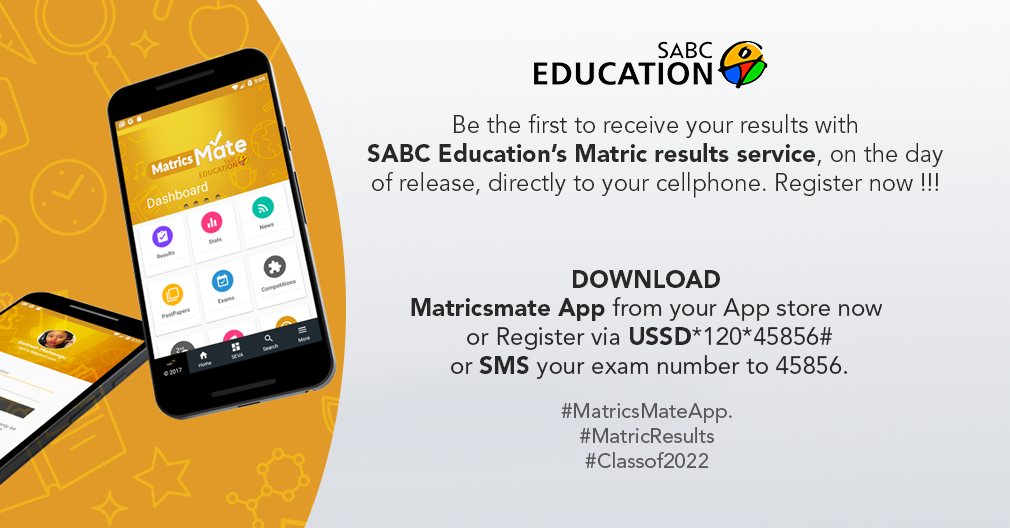
To enter, Download the MatricsMate App from your Google Play store or App store or Register via USSD*120*45856# or SMS your exam number to 45856, share the dashboard of your Matricsmate App pre-login or proof of SMS registration on our Facebook, and Twitter platforms, tag your friends, and like our Page.

  1. To enter, you need to be following SABC Education on Facebook, Twitter & SEVA on Instagram, and share your dashboard of the MatricsMate App or share the proof of your SMS registration, and send a screenshot to SABC Education’s social media platforms using the following hashtags #MatricsMateApp #MatricResults #ClassOf2022
  • The MatricsMate App is free for download on Google Play and Apple App Stores. You will need your 13 digits ID number and exam number to register.
  • The competition runs from the 16th of January 2023 to the 1st of February 2023.
  • Winners will be chosen randomly.
  1. Correct entries received by the advertised deadlines will be considered for the draw. Any late entries received will not be taken into consideration.
  1. Winners will be contacted by the SABC to verify the following: name, surname, ID number, address, and all other relevant details.      
  1. Winners who are not contactable by phone or Facebook, Twitter or Instagram direct message at the time of the competition draw will be disqualified after 48 hours and a new winner will be drawn.                                                                                                                                                                                                                                                                                                                                             
  • The MatricsMate App is open to all South African citizens except directors, members, partners, employees, agents, service providers and consultants of SABC, as well as any SABC employee including agencies, UIP and/or their spouses, life partners, parents, children, brothers, sisters, business partners or associates.
  • The prize will comprise a share of R10 000.00 in airtime vouchers
  • Winners will be announced every week on the following platforms:
  • Facebook
  • Twitter
  1. Prizes are not transferable and cannot be deferred or exchanged.
  1. Prizes will be made available to the winners from the 6th of February 2023.
  1. The SABC and its agents accept no responsibility for any problems or technical malfunction of any communication network or any late, lost, incomplete, misdirected, incorrectly submitted, delayed, illegible or corrupted entries. The SABC and its agents are not liable for any costs incurred, responses received or any other consequences of user error.
  1. The judges’ decision is final and no correspondence will be entered into.
  1. Entrants will be deemed to have accepted these rules and agree to be bound by them when entering.
  1. The SABC and its agents reserve the right to cancel, modify or amend the competition rules at any time, if deemed necessary in its opinion, and if circumstances arise outside of their control.

SABC EDUCATION LAUNCHES THE 2022 MATRIC RESULTS CAMPAIGN

Issued: 16 January 2023

SABC Education in partnership with the Department of Basic Education (DBE) is launching its Matric Results service which runs from 16 January until 28 February 2023. The Minister of the Department of Basic Education will release the senior certificate results on Thursday, 19th January 2023 and the candidates’ results on Friday, 20th January 2023.

The SABC Education Matric Results service will release the results to all students across all Provinces who have registered using the SMS, USSD and MatricsMate App on the mid-night of the day of the release.

We encourage learners to pre-register using the SABC Education Matric Results service, and just by registering with us you stand the chance to win instant airtime!

Register using any of our registration mechanisms, either SMS or USSD and you stand the chance to WIN your share of R10, 000 in airtime! You can also download our MatricsMate App from Google Play and Apple App Stores to receive your National Senior Certificate Examination results.


Learners should register with their exam number on the platform of their choice to access their results.


Register on our mobile services to receive your 2022 Matric Results:

SMS

  • SMS your exam number to 45856
  • The system verifies the Exam number; your exam number must be correct in order to be accepted.
  • Learners will be charged R1,50 per SMS, free SMS’s do not apply

USSD

  • Dial *120*45856# enter exam number to register
  • You will be charged R1,50 per minute on USSD.
  • Results will be sent to your phone once they are available

MATRICSMATE  APP

  • Download for free from Google Play and Apple App Stores

Should the learners have queries relating to registration and the use of the SABC Education Matric Results service, they can contact our call centre on 011 507 4755, Monday to Friday from 8am to 5pm. However, on the day of the release, the call center will operate from Midnight to 5pm.

For further details on the SABC Education Matric Results services, contact Raymond Moruku, Project Manager for Matric Results campaign, SABC Education, morukurk@sabc.co.za or visit www.sabceducation.co.za.

Embargo on the publication of results: 

The 2022 National Senior Certificate (NSC) examination results will be released at the different schools at 08:00 on Friday, 20 January 2023. These results will be made available to the media houses/service providers on Thursday, 19 January 2023, at 07:00. The publication of results will be embargoed until 06:00 on Friday, 20 January 2023 for all PEDs results, except in the Western Cape.

The Western Cape data will be released to the media houses/service providers on Friday, 20 January 2023 at 12:00. It must be emphasized that the integrity and credibility of the examinations depend on how the results are handled by the various service providers. Failure to abide by the above-mentioned conditions will result in legal action against the recipient of the data, and the recipient will be barred access to all examination results/data in future.

NB: Bursaries are available from NSFAS for any course of study. Contact NSFAS on 08600 NSFAS (0860067327), e-mail info@nsfas.org.za or visit www.nsfas.org.za.

SABC Education: Enriching Minds, Enriching Lives”.


END

Zizi and Hannibal: A local animated series coming to SABC2!

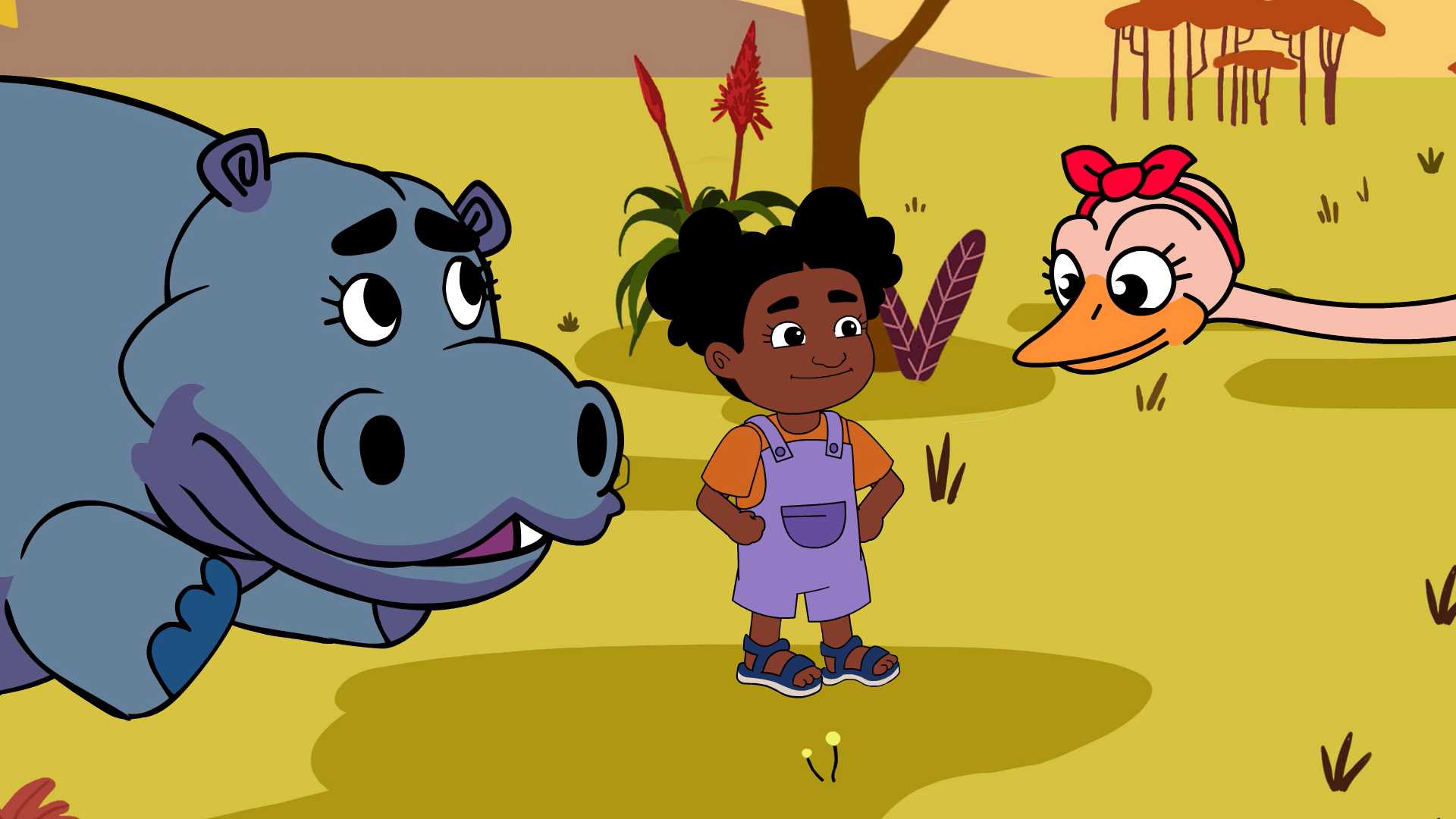
Meet Zizi, a curious young girl who has a lot of questions about the world around her. Zizi has a friend, Hannibal, a rather awkward but hilarious hippo who accompanies her on daily adventures to the World of Wonders, where they meet many interesting animal friends!

There’s never a dull moment with Zizi and Hannibal! Gogo, Zizi’s wise grandmother is always there to put things into perspective and always encourages Zizi to use her imagination and indulge her sense of wonder.

Tune in on SABC 2 on Mondays at 15h30 to catch Zizi and Hannibal’s African adventure, starting on Monday, 05th December.

This is made possible by Pixxcomm, in collaboration with SABC 2, SABC Education, IDC, and False Bay College.  

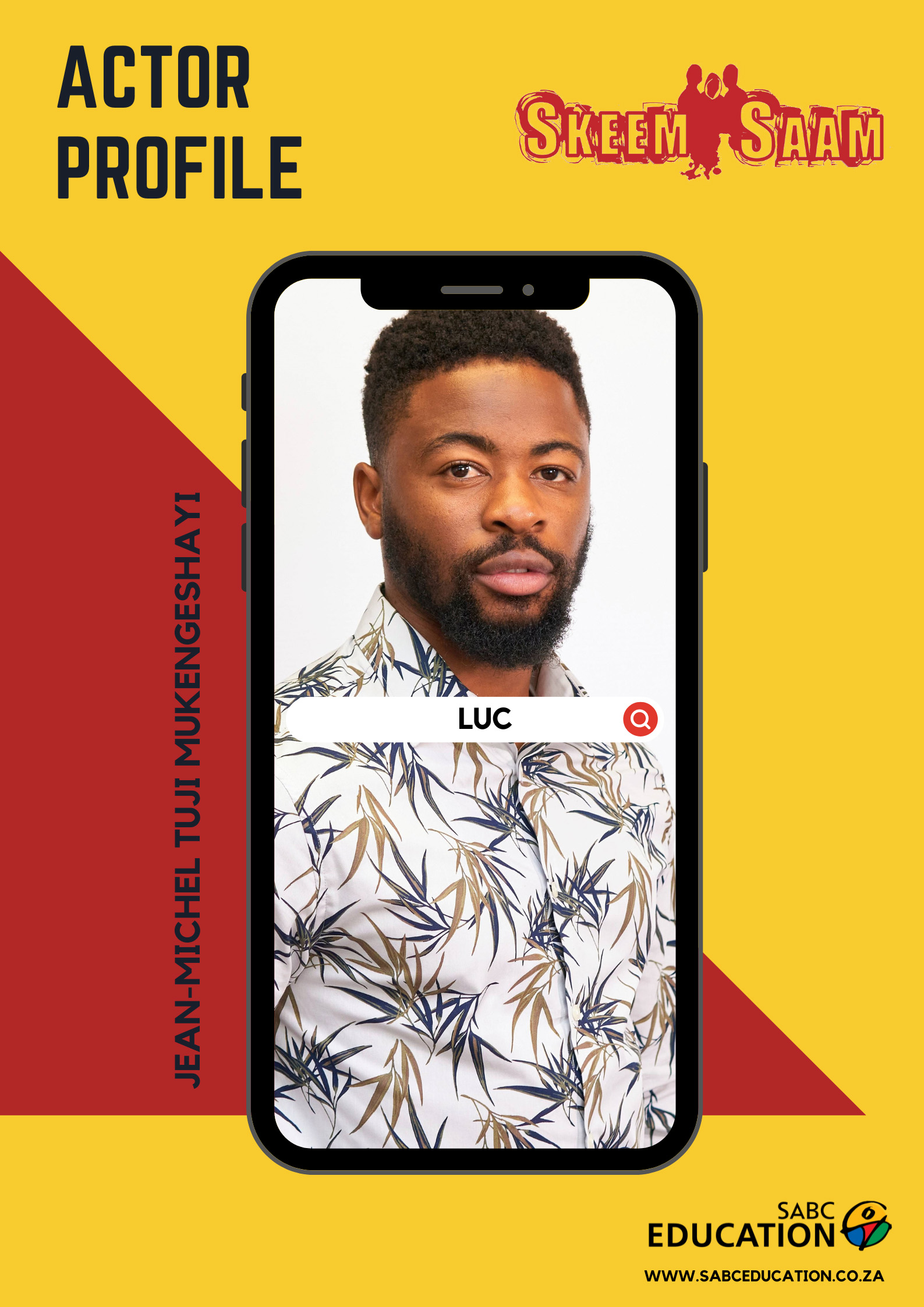
Jean-Michel Tuji Mukengeshayi

Jean-Michel was born in Lubumbashi, Congo and he was raised in Jacaranda city, Pretoria. He feels fortunate to have attended schools in both Congo and South Africa with his foundation phase being in Congo. From Grade 5 onwards he attended Glenstantia Primary School, then went on to Hoërskool Lydenburg and The Glen High School, where he matriculated in 2011. Thereafter he attended Rosebank college and SAB&T Academy.

Jean-Michel is most passionate about 3 things: Soccer, God, and Family. He also loves music and enjoys being in front of the camera. He’s been modeling for the past 2 years and has shot a number of TV commercials. “Funny enough, being an actor was never my end goal, but I always wondered how I’d do as an actor. The opportunity to dabble in the arts really happened to find me – a friend had posted something about an agent looking for Congolese actors; I submitted my tape and it was a match made in heaven. I couldn’t believe that it was for Skeem Saam”, he says.

Jean-Michel is a fresh new face to the Skeem Saam family. He plays the character of “Luc” a good-looking, charming young man, who when we first meet him, is admitted into Turf Hospital for having bad headaches. But those headaches quickly disappear after he meets and falls head over heels in love with his doctor, Lizzy Thobakgale. But to Lizzy’s dismay, she soon finds out that Luc is a scammer and has been scamming women out of their money all over the country.

When asked if him and ‘Luc’ have anything in common, this is what he had to say: “In terms of banter, we’re pretty similar. Flirting comes naturally to me as I’m smooth with my words, so ‘Luc’ and I are similar in that regard. But as for scamming, I keep my hands squeaky clean”, he laughs.

Tune in to #SkeemSaam every weeknight on SABC1 at 18.30 pm and Omnibus every Sunday mornings from 9.30.

World Food Day Conference 2022 Solution-Oriented Dialogue around Leave No One Behind and Absorbing the Shocks: Climate Change and Food Security

Johannesburg, South Africa: SABC Education, The Food, Agriculture and Natural Resources Policy Analysis Network (FANRPAN), the Food and Agriculture Organization of the United Nations (FAO), and vikela earth are jointly organising the virtual World Food Day Conference 2022. The Conference aims to support the credo of  “Absorbing the Shocks on Climate Change and Food Security”.

The Conference will be looking at how to transform into a world free of hunger, through a critical review of investments in research and development for innovation, the governance of resources, healthier diets and more sustainable production, stronger value chains, inclusion and social protection, and climate-smart finance.

In the face of the current global crises, global solutions are more important than ever. By aiming for better production, better nutrition, a better environment, and a better life, we can transform agrifood systems and implement sustainable and holistic solutions that allow for development in the long term, inclusive economic growth, and greater resilience. A sustainable world is one where everyone counts.  Food security is imperative for human survival with dignity.

The Virtual Conference will be held on Tuesday, 25th October 2022 from 15:00 – 17:00 CAT and is free and open to anyone wishing to attend. The registration link can be found here: ​​

https://us06web.zoom.us/meeting/register/tZIqcemtqzwtHdP1p4-3qUWN3ETacz70CYjG

The programme includes an impressive line-up of speakers and a diverse panel of subject matter experts. (should we include all of these….)

Organisers:

Food, Agriculture and Natural Resources Policy Analysis Network (FANRPAN)

Contact: Ms Sithembile Mwamakamba at smwamakamba@fanrpan.org

United Nations Food, Agriculture Organization (FAO)

Contact: Steven Lazaro Steven.Lazaro@fao.org

South African Broadcasting Corporation (SABC) Education

Contact: livingland@sabc.co.za

Vikela.earth

Contact: Nozipho Ndiweni at Nozipho@no-line.co.za

About Food, Agriculture and Natural Resources Policy Analysis Network (FANRPAN)

The Food, Agriculture and Natural Resources Policy Analysis Network (FANRPAN) is an all-inclusive multi-stakeholder pan-African network that provides independent evidence to inform and influence policy processes at national and regional levels. FANRPAN is a multi-tiered network consisting of a regional secretariat and established national nodes, currently present in 18 African countries, and growing. FANRPAN has nodes in all Southern Africa Development Community (SADC) member states. The network’s membership includes food, agriculture and natural resources (FANR) related government departments, parliamentarians, research and farmer organisations, the private sector, civil society organisations and the media.

For more information, please visit: www.fanrpan.org  

About South African Broadcasting Corporation (SABC) Education

Established in 1996, SABC Education is an SABC business unit responsible for delivering the educational mandate of the public broadcaster. In true South African social tradition, SABC Education meets this challenge by delivering compelling educational content for a diverse audience in South Africa and the rest of Africa. SABC Education’s content is focused on a wide range of educational issues and contributes to a rich shared South African identity. Enriching Minds, Enriching Lives!

For more information, please visit http://www.sabceducation.co.za

About Vikela.earth

At vikela.earth we help drive the evolution of environmental conservation research and the development of sustainable solutions, with a focus on people, profit and the planet. We do this through meaningful collaboration with the best hearts and minds in business, science, and the arts and education to create ongoing awareness, improve research methodology and support grass-roots, purpose-driven projects aimed at protecting our environment and uplifting communities. For more information, please visit: https://vikela.earth/

EDUCATION-SPECIFIC VR HEADSET FOR STEM SUBJECTS

The headset contains Veative’s full educational content library within the all-in-one EduPro headset. Does not require a computer or connectivity

Sangari Education, distributor of the Veative virtual reality (VR) library of STEM-related content, has launched the Veative Edupro headset specifically for educational use.

“While the Veative content can be used on many popular headsets, the EduPro provides a more cost effective and user friendly headset. Veative has developed a large library of STEM-related content of 543 modules, which have been mapped to the South African Curriculum for Maths and Science grades 7 to 12,” explained Sangari Education MD, Bez Sangari.

“The EduPro headset, being specific to educational applications, introduces enhanced features over competitive products that don’t focus specifically on educational applications.”

“This full content library resides on the all-in-one EduPro headset which does not require a computer or connectivity, making it easy to use.”

“For those schools who would like to give their teachers and students the opportunity to develop their own content, Veative has produced a VRcreate software which makes content development easy and accessible to all,” Mr Sangari added.

He explained that the Veative EduPro is the world’s first XR1 chip-enabled mobile VR device designed specifically for educational use. “The preloaded Veative VR content library within the headset provides convenience and removes the need to load and unload modules manually.”

The VR headset has 128Gb of internal storage, sufficient space for Veative’s entire library and for additional content. “The operating system is built for education, and there are no social media or privacy concerns or distracting applications,” Mr Sangari said.

The headset includes a built-in Mobile Device Management (MDM) feature and has a MicroSD card slot for further expansion, an Integrated touchpad, and handheld Bluetooth controller.

About Sangari Education

Sangari Education has a clear vision of what it aims to achieve as an Education Solutions company focusing on Industry 4.0. Sangari is eager to inspire clients with support and training to achieve their full potential. Sangari subscribes to the viewpoint that there is a direct correlation between education and decent jobs. Our philosophy is to apply sound business principles, and together with modern technology we help our clients establish and maintain a modern and efficient education system and in every instance producing measurable results. Our teaching philosophy is founded on augmenting teachers’ skills and making learning exciting for students. Sangari incorporates a blended learning approach that integrates theory with practical experience, creating the ideal teaching and learning environment.

Veative history and Philosophy

Starting out in 2016, we were determined to create a VR learning experience based around these key assumptions: 

·        We would focus on one core topic or concept at a time 

·        We write and develop around curriculum standards 

·        We tackle abstract or conceptually difficult concepts first (for students) 

·        We have assessments within the environment to ensure that teachers are connected with the learning, without needing to hover, monitor, or babysit 

·        All content should be available online and offline (no network dependency) 

·        It should be localizable for different regions and languages

·        It should be cost effective, ensuring no one is left behind 

From the start, we choose to be device-agnostic, hoping to leave the VR hardware decision to schools and districts. We wanted to make our content for all devices. However, the reality of the market created problems, not just for us, but for everyone. From small storage sizes on devices (meaning the content cannot be used offline), to dropped controller signals in larger classrooms, we lived through it all on the hardware side. We learnt quickly that devices made for gaming and entertainment are NOT education-focused, nor education-ready. As educators in this market, we need to be concerned about privacy and security issues, management of content (so that it is easy, and not even a concern, for teachers), a breadth of content (ensuring every student, in every class we have content for has meaningful things to learn and interact with), and proper thought toward the experience of students, teachers, IT and admin. Gaming and entertainment devices have NO thought toward any of these issues. So, to address the needs of schools and districts everywhere, we designed the EduPro VR headset, a device purposefully built specifically for education.

SABC 2 HERITAGE DIGITAL COMPETITION

  1. ENTRY: Participants of this competition are required to read and fully understand the terms & conditions of entry on Facebook.
  2. The competition will run from Tuesday, 20 September 2022 to Tuesday, 27 September 2022.
  3. The competition is open to all South African citizens except directors, members, partners, employees, agents, service providers, and any SABC employee including agencies, and/or their spouses, life partners, parents, children, brothers, sisters, business partners, or associates.
  4. Winners will get the following:
    a. SABC 2 Hamper
  5. Winners will be contacted by the SABC to verify the following: name, surname, ID number, and address.
  6. Winners, who are not contactable by phone, after the closing date/time, will be disqualified and a new winner will be drawn.
  7. The SABC and its agents accept no responsibility for any problems or technical malfunction of any communication network or any late, lost, incomplete, misdirected, incorrectly submitted, delayed, illegible, or corrupted entries. The SABC and its agents are not liable for any costs incurred, responses received, or any other consequences of user error.
  8. The judges’ decision is final and no correspondence will be entered into. The SABC or its agents will not be held responsible for any disputes arising from the competition or prize awards.
  9. Prizes are non-transferable, and cannot be deferred or exchanged.
  10. Winners use prizes at their own risk. The SABC and its agents shall not be liable for any loss (including, without limitation, indirect or consequential loss), damage, personal injury, or death that is suffered or sustained (including but not limited to that arising from any person’s negligence) in connection with this competition or accepting or using the prize/s.
  11. Entrants will be deemed to have accepted these rules and agree to be bound by them when entering.
  12. Winners will be selected from a random list of correct entries.
  13. The prizes will all be couriered to all the winners by end of the competition.
  14. If an entrant contravenes these rules, the entrant may at the discretion of the SABC be disqualified from the competition.
  15. Entering this competition line indicates acceptance of all the above rules.