Johannesburg, 15 September 2022 – It is with great sadness that the South African Broadcasting Corporation (SABC) has learnt of the untimely passing of former YoTV presenter and content producer, Lumko Johnson Leqela who passed away on Wednesday 14 September 2022. Lumko was dynamic and passionate about human rights issues and storytelling. The SABC sends its heartfelt condolences to their family, friends, and colleagues.
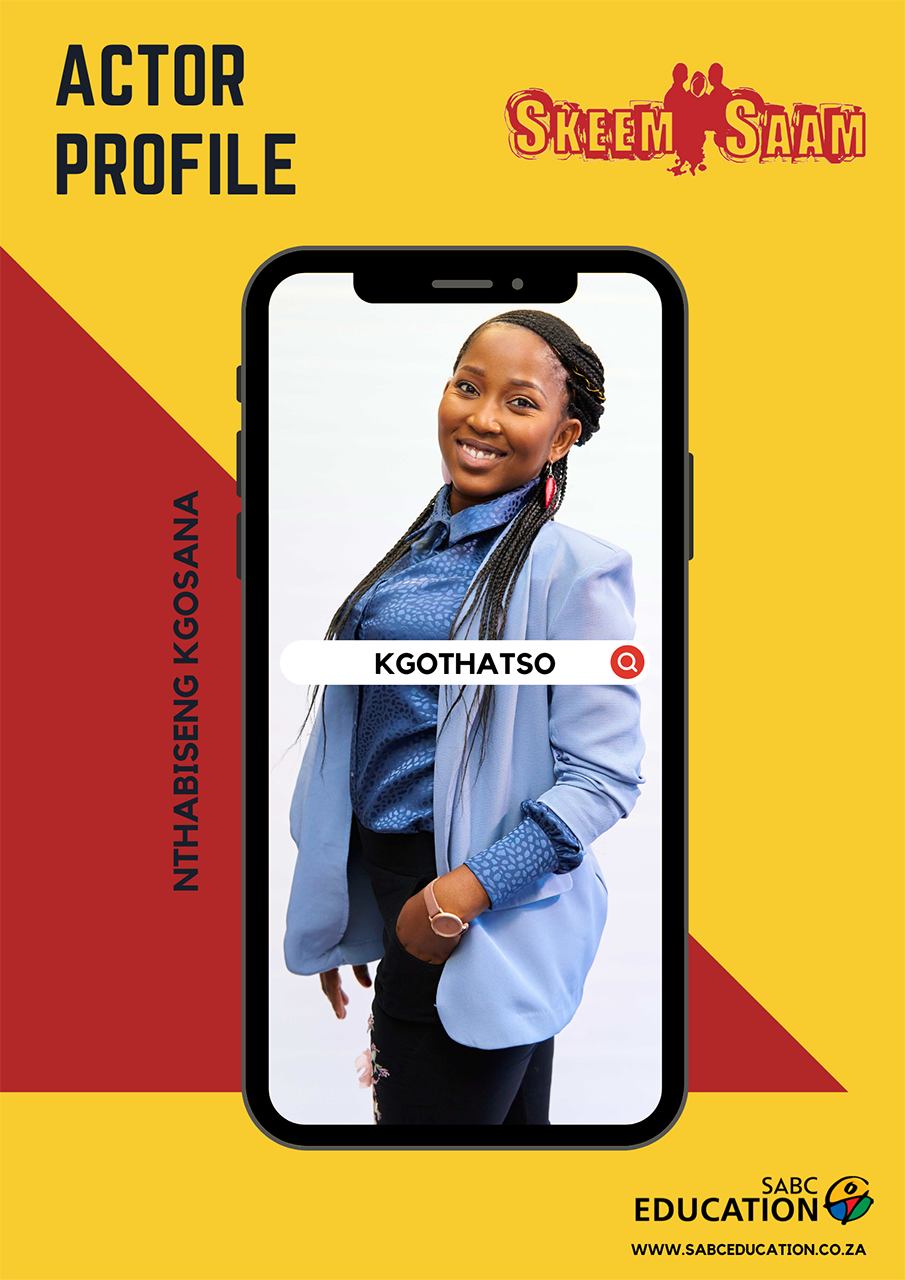
Nthabiseng Kgosana grew in Alexandra Township, but is originally from Vaalbank, In Mpumalanga. She attended Minerva High School where she was crowned 2nd princess in 2004 and 1st princess in 2005 in the Miss Minerva High School pageant. After high school, she obtained her qualification in BCOM Accounting at UJ.
Her first production that she was ever part of was being part of the AFDA final year student project in 2017 where she was headhunted by an agent. The second one was a short film called ‘Boshego’ with Worthy Film Productions in 2017.
When asked why she chose acting, she said, “I believe that acting chose me. Since pre-school, I was always one of the pupils chosen for plays. I’ve been in instances where I would accompany a friend to a certain community hall and end up being part of the actors. I remember back in high school in grade 8 I was looking for my friends, I accidentally opened a class where senior students were practicing drama – on that very same day of watching them practice, I joined and I impressed the guys who were directing the drama. Also unlike the corporate world that drains me in various aspects, I’ve realised that I love working in the entertainment industry because every time I leave the studio I enthusiastically look forward to the next day.”
Her 3rd and biggest production is Skeem Saam. Where she played the role of ‘Kgothatso’, Leshole’s girlfriend. An appealing woman that has good fashion sense and is dedicated to her job and her daughter. She is well-spoken and confident. Her desire was always to one day settle with a good man and although she had her doubts at first, she eventually believed that Leshole was that guy.
#SkeemSaam airs every weeknight on SABC 1 at 18.30pm
Research covering higher education (HE) instructors’ priorities and challenges in course delivery conducted by education technology company Cengage EMEA indicates that prior to COVID, South Africa had the highest percentage of learners receiving online or blended learning as their main mode of course delivery compared with the UK, Middle East and Europe.
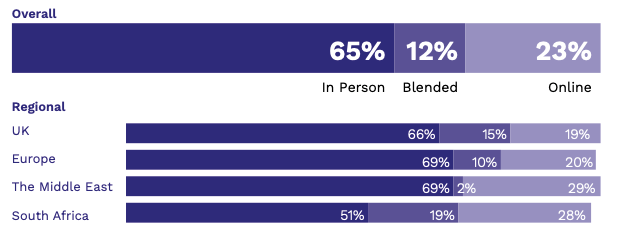
South Africa had a pre-COVID online and blended learning course delivery of 47% compared with the UK at 34%, the Middle East at 31%, and Europe at 30%.
The survey covering 402 HE instructors indicated South Africa having the lowest percentage of In-Person learning at 51% followed by the UK (66%), Europe (69%), and the Middle East (69%) prior to COVID.
Overall, two-thirds of the higher education instructors were delivering their course content in-person pre-COVID, with just a quarter predominantly delivering their course content online.
The results may indicate that SA was moving at a faster pace towards online learning prior to COVID. Another factor could be that in SA, courses are generally much larger, some with thousands taking a course, and therefore online would be better suited for managing very large cohorts.
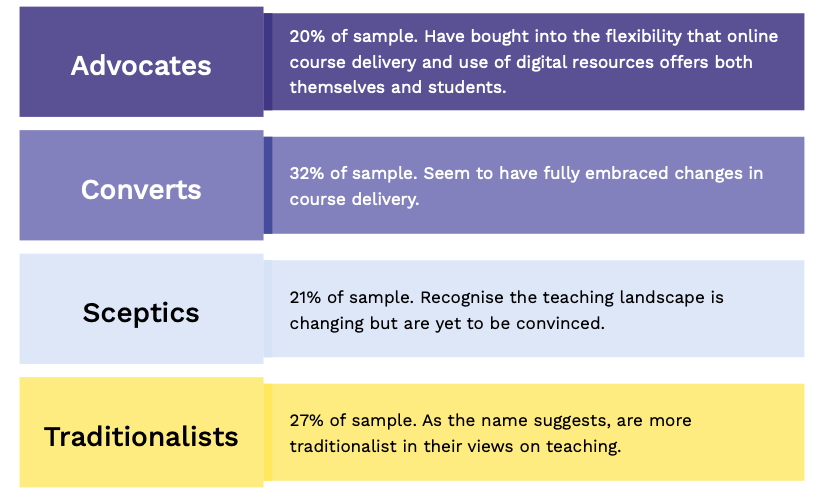
Segment membership In the research, Cengage EMEA identified four core instructor segments that the company says go some way to distinguishing attitudes to the use and future use of digital content and delivery in higher education settings. Cengage has called these segments: Advocates, Converts, Sceptics and Traditionalists. The largest group of instructors were designated as ‘converts’ and the second largest group ‘traditionalists’. Each segment shared particular characteristics, as seen below:
Resources Used
Also prior to COVID, it was found that a combination of resources to deliver courses was used, with basic digital resources such as eTextbooks, instructor PowerPoints, and instructor notes, being part of this and used by 77% of the overall sample.
In combination with these basic digital resources, instructors representing half the sample were typically using ‘reading from print textbooks’, ‘lecture notes’, ‘practice questions’, and ‘practical sessions’, alongside journal articles. Journal articles were significantly more likely to be used in the UK (62%) compared to other regions, whilst the UK was also significantly more likely to use published materials (63%) and recorded lectures (38%).
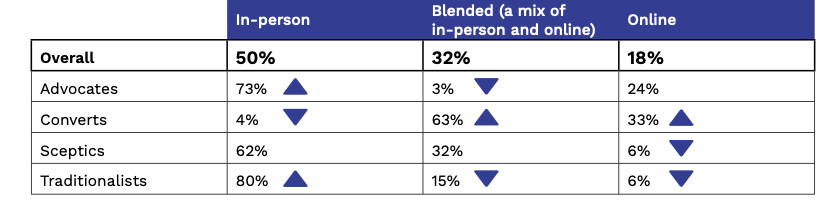
TEACHING PREFERENCES By the time the study was carried out, COVID-19 had disrupted teaching in most higher education institutions (HEIs) for over a year, forcing many to move their teaching online. The sample was asked: Thinking about your own teaching preferences, how would you prefer to teach your course?
Overall, HE instructors showed a preference for either in-person or a blended mix of online and face-to-face teaching. However, preference differences were noted across the segments, with ‘advocates’ showing a significantly greater preference for in-person teaching and lower for blended.
‘Converts’ showed a significantly higher preference for a blended or online approach to course delivery, whilst ‘traditionalists’ evidenced significantly higher preferences for in-person teaching and much lower preferences for blended or online teaching, suggesting that they are more rigid in their in-person preferences. ‘Sceptics’ showed a lower preference for online only.
Thinking about your own teaching preferences, how would you prefer to teach a course?
Regionally, European instructors showed a significantly greater preference for in-person teaching (62%), whereas those in South Africa show a significantly lower preference for in-person teaching (31%).
Core reasons for preferences:
In-person
preferred interaction and contact
can see if students understand the course I’m teaching
it’s easier to demonstrate something
Blended
provides flexibility for students
some aspects need in person interaction
Online
provides flexibility for students
flexibility for me to teach around family and personal commitments
THE REALITY OF DELIVERING COURSES USING DIGITAL CONTENT
Understandably, the enforced move for HE institutions to deliver teaching online to their students over the course of the pandemic met with a range of responses. Through the study, Cengage EMEA says it wanted to gauge the perceived benefits and challenges of using digital content to deliver teaching so that education providers and content providers, It can work together to further improve any future experience of this for educators and students alike.
Perceived benefits
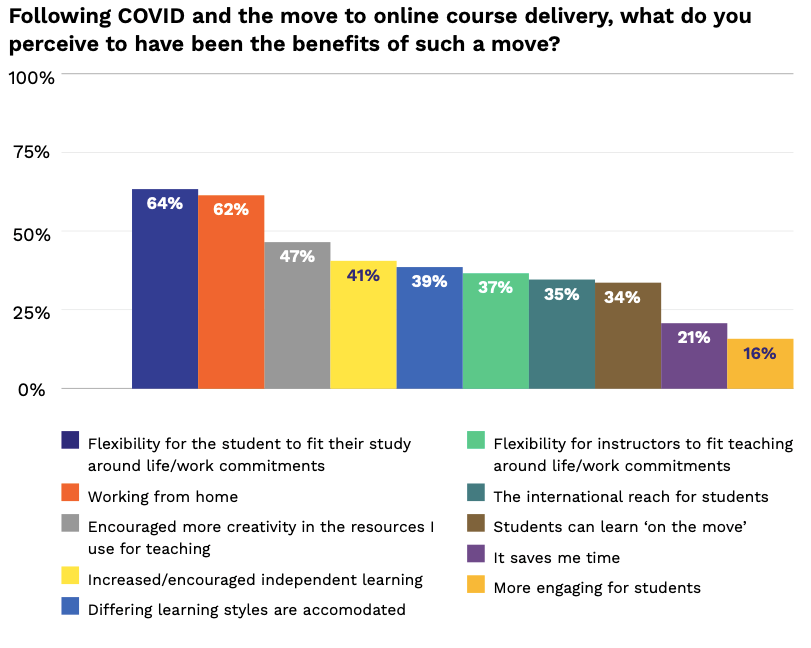
The sample highlighted many perceived benefits in making the transition to online course delivery. The main benefits of online course delivery highlighted by instructors included:
flexibility for students (64%)
instructors being able to work from home (62%)
encouraging more creativity in resources used by instructors (47%)
increasing independent learning (41%).
Following COVID and the move to online course delivery, what do you perceive to have been the benefits of such a move?
Unsurprisingly, the ‘converts’ segment were most likely to perceive a fuller range of benefits than other segments, whilst also noting additional benefits of embracing online course delivery such as accommodating different learning styles, the flexibility for instructors to fit teaching around life-and-work commitments and allowing students to ‘learn on the move’. ‘Traditionalists’ were more likely to perceive fewer benefits of an online mode of teaching.
Perceived drawbacks
When asked about the perceived drawbacks of online course delivery, the most commonly cited drawback will be recognisable to anyone that endured lockdown in some form. Just over a fifth (21%) claimed that the core drawback was the students missing social interaction.
However, they also cited the difficulty in assessing student understanding, which is something that some digital solutions can aid educators with. It is notable that ‘sceptics’ tend to express more drawbacks with online course delivery than the other segments and were more concerned about assessing student understanding and engagement, which, again, digital solutions can offer assistance with.
Across the regions, there was a little discrepancy, with the exception of Africa where ‘broadband issues’ was the key concern for a third of instructors, as well as the perception that students find the use of technology stressful. It is likely that these two issues are related.
Potential concerns
Some wariness to moving courses online, particularly at short notice, is understandable. To gauge this the sample was asked: During COVID, which of the following potential concerns, if any, have you had about delivering online courses?
The main concerns expressed were around students’ motivation and engagement, but also instructors had concerns around their own ability to deliver certain aspects and having to potentially rewrite course content, which is presumably a time issue.
Meeting expectations
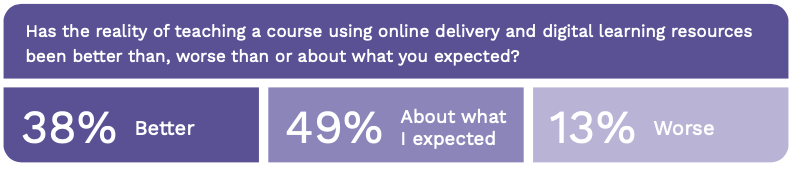
That said when asked about the reality of teaching a course using online delivery and resources the experience for just under half of the instructors predominantly met expectations. Whilst almost 4 in 10 agreed that teaching a course using online delivery and digital learning resources was a better experience than they had anticipated.
For those that stated that the experience of teaching a course using online delivery and digital learning resources was better than expected, the reasons given included:
Students actively engage online / better student engagement (15%)
Flexibility for students / teachers (9%)
Students/teachers adapted well (7%)
The technology worked well (7%)
Although no differences were observed by region, there were differences noted by segment.
‘Sceptics’ significantly more strongly felt that the experience had been worse than they expected (43%), whereas ‘advocates’ and ‘converts’ believed it to be a better experience.
Those who had expressed greater confidence in delivering digital content had a more positive experience (43%), which suggests that familiarity with digital content is beneficial. Where expectations were not exceeded, this is mainly due to initial concerns being realised, lower student engagement; time consuming etc.
This seems to reinforce the view that the more practiced and confident educators are with using digital learning resources, the better their experience and the more likely they are to notice the benefits of using such resources.
So, where does this leave instructors? Online learning is now increasingly important and impactful to the improvement of the teaching and learning experience. To realise the full potential of technology-enhanced learning, help, and support for instructors to develop digital and pedagogical tools to teach effectively both in remote and in-person settings is an imperative factor in course delivery in higher education.
Mahlatse Moropo is a young South African actor born and bred in Polokwane, Limpopo. Turning 18 this year, Mahlatse is a grade 11 learner at Northern Academy Secondary School. “I love school especially because of the subjects I am currently doing. I do drama, dance, and even sports,” he says. He also expresses gratitude to be at a school where his teachers and peers are supportive of his career.
Mahlatse is an MC, choreographer, dancer, and voice-over artist. But he is best known for the character of Charles Kunutu’s son, ‘Letetswe’ on Skeem Saam. He had auditioned for the role in September 2021 and was ecstatic when he was informed that he had gotten the role. “I had received an email telling me that I bagged the role of ‘Letetswe’ and it was one of my happiest moments,” he said.
‘Letetswe’ is friendly, opinionated, and outgoing. Family is important to him and he is very protective of his cousin, Mahaltse Kunutu.
#SkeemSaam airs every weeknight on SABC 1 at 18.30pm
Boasting a whopping 26 years of her television career, Mmola has been playing the character of ‘Celia’ on Skeem Saam for 10 years and in that role has been one of show’s lead actresses, contributing to its accomplishments over the past decade. Always keeping fans entertained, Mmola has portrayed the character of ‘Celia’ impeccably.
She will be missed by fellow cast members, crew members and viewers watching at home.
We wish her well and all the best with her future ventures.
Mmola will not be featured in the new season starting Monday 4th July 2022.
SABC Education celebrates the Legacy of the shows they have produced in the past years.
Since its formation in 1996, SABC Education has been instrumental in educating the nation through its programming.
The SABC as the only public broadcaster in South Africa has a responsibility to entertain, inform and educate all South Africans.
SABC Education continues to fulfill its mandate to educate. The past 25 years Plus, has seen the SABC carry out content such as Khululeka Siyavota, the flagship democracy programme, designed to address issues related to voter education, the secrecy of a vote, and the emotional readiness of voting in preparation for South African elections in 2009.
SABC Education has also played a role in discovering and giving a platform to young presenters through some of its programmes including SABC1’s youthful shows Take 5 and YoTV, SABC2’s School TV and Hectic Nine-9, and Hectic on 3 currently flighting on S3.
In keeping young people off the streets, programming like Skeem Saam, iSpani, Daily Thetha, Teenagers on a Mission, and Cave Quest has been commissioned.
SABC Education celebrates the Legacy it created in educating through the shows it produced.
Here’s to 25+ Years of SABC Education. Enriching minds. Enriching Lives.
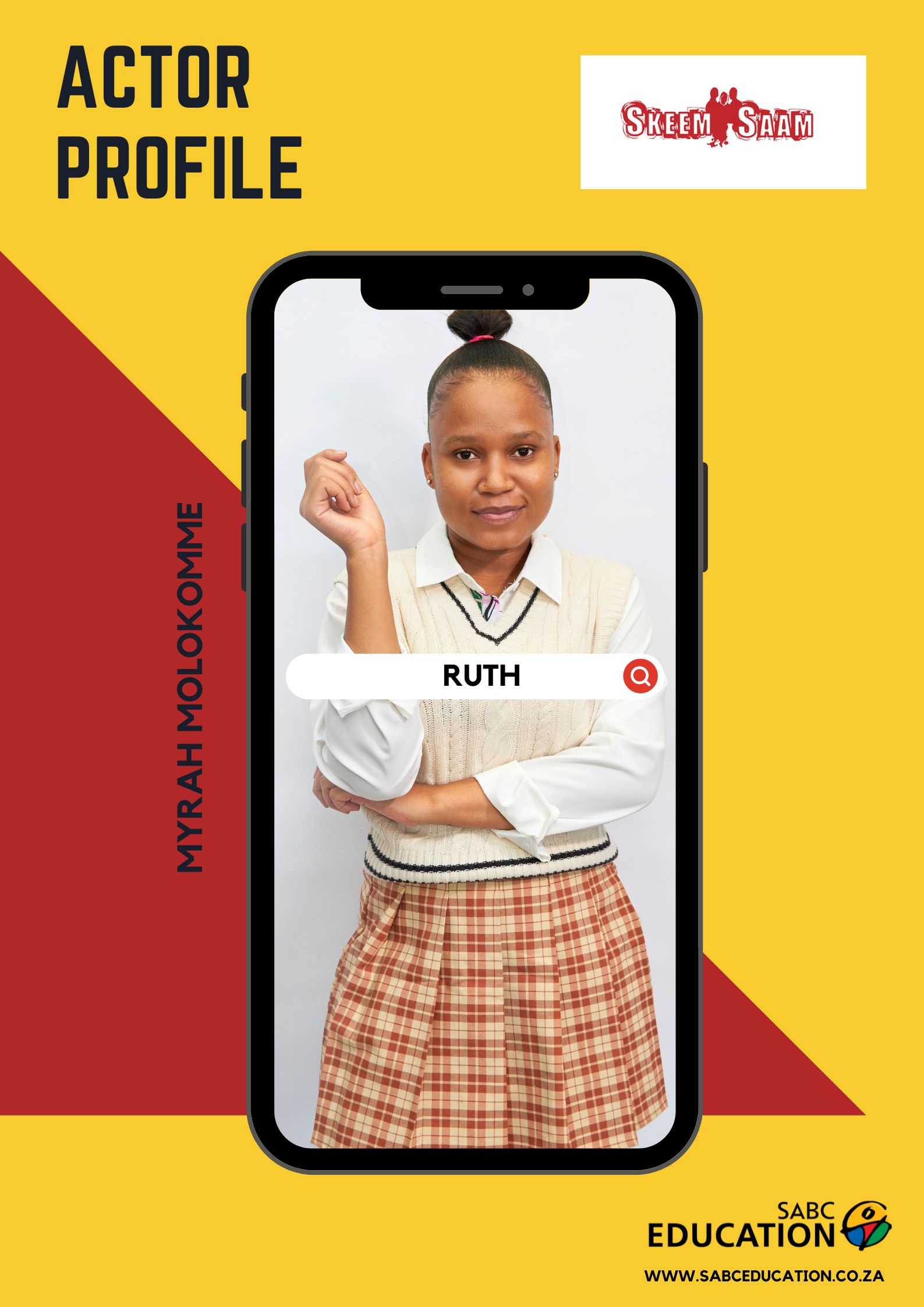
Myrah Molokomme is a South African actress born and bred in Limpopo. She holds a BA in Performing Arts (Writing and Performance) obtained at the University of Limpopo.
She trained for three years in theatre towards the completion of her degree at the University of Limpopo. In 2017 she featured in a stage adaptation of Lucas Mokuti’s novella ‘TSIETSI’ which was written for stage and directed by Ola-Kris Akonola. In 2018 she featured in the play ‘THE PRINCE OF SOVENGA’ which was written and directed by Ola-Kris Akinola. Myrah’s ability to act was recognized by the University of Limpopo with an award for ‘Best Actress’ in 2017.
In late 2018 she landed her first role on the local drama series Skeem Saam where she portrays the character of Ruth.
We first met Ruth at Turfloop High as a Grade 11 student who was born and living with HIV. She made the decision to disclose her HIV status to her now long-distance boyfriend, Koloi, who then accused her of deceiving him before he was better educated about the disease. After passing Grade 12 with flying colours she received a good bursary to further her studies in BSC Genetics at the University of Cape Town.
Unfortunately, after losing her bursary due to poor performance in varsity, she was forced to move back home. Thankfully, with support from people like Koloi, Mapitsi, and Principal Thobakgale, Ruth was able to claim funds that were due to her via her late parents and their GEPF benefits.
We can only hope that she can go back to Cape Town and complete her course and uses her money wisely.
#SkeemSaam airs every weeknight on SABC 1 at 18.30pm
Global education technology company Cengage has launched a first-to-market subscription service for textbooks for South African higher education institutions.
The company says the subscription service, Cengage Unlimited for Institutions (CUI), allows students to access an unlimited number of courses from a library of 10,000 digital products including eTextbooks, online learning platforms and study tools covering 675 courses – all from one source at one affordable price irrespective of the number of materials used.
“Cengage Unlimited for Institutions is not just another online learning offering – it is the only comprehensive service that includes access to everything a student needs to learn – eTextbooks, learning platforms, study tools, online homework and skill-building resources to develop employability skills. Subjects covered include accounting, science, maths, psychology and engineering amongst many others,” explained Andrew Robinson, Vice President, General Manager of International Higher Education at Cengage.
Cengage already supports more than three quarters of public and private South African universities with in-person, blended and online courses. Their digital resources are used to support student outcomes and improve student engagement, digital literacy, the learning experience and employability skills.
University of Pretoria, North West University, University of Cape Town and the University of Johannesburg are some of the institutions successfully using Cengage’s digital platforms to address their higher education needs.
“Cengage Unlimited is designed to address one of the major challenges facing higher education, and one exacerbated by the crisis over the last two years, namely fair and equal access to learning materials. Affordable and accessible course materials can make the difference between a student dropping out or completing their degree,” explained Andrew Robinson, Vice President, General Manager of International Higher Education at Cengage,” Mr Robinson added.
“This ‘all-you-can-eat’ subscription service is now available in South Africa through an institution or faculty pay model. Cengage Unlimited revolutionised the traditional textbook model in 2018 when it was first launched to the US market, and has since helped nearly 4-million students,” he said.
The Department of Mathematics and Statistics at University of Cape Town is using Cengage’s WebAssign, one of the platforms included in Cengage Unlimited for Institutions, to provide content, online study functionality, and efficient homework assigning and grading to a large Calculus course of 800 students. The platform is specifically designed for STEM subjects and provides course content, homework, tests and practice problems with instant assessment and has been shown to improve student grades.
The results from 276 students who responded to a survey demonstrated that students were provided with all the resources they needed to succeed in Calculus and the students’ experience had been positive.
The Psychology Department at North-West University (NWU) used another of Cengage’s platforms, MindTap – also included in Cengage Unlimited, for their Introductory Psychology module to help a large cohort of students with their self-study and comprehension of key introductory concepts. MindTap is a fully customisable online teaching and assessment tool that includes videos, test banks, interactive study tools and access to eTextbooks.
At NWU, positive survey responses both quantitative and qualitative, showed that students were satisfied with the convenience of mobile digital resources and interactive self-test activities to help prepare for exams. The survey indicated that students appreciated the read-aloud feature as well as being able to access the full textbook and practice activities on their cell phone to study anytime, anywhere.
“Cengage Unlimited has been successfully piloted in EMEA over the last 12 months in Ireland, Switzerland and Saudi Arabia to ensure the diverse needs of our instructors and students in the EMEA regions are met through this new subscription platform.”
“The pandemic had major implications for students and institutions alike. During this time, Cengage worked closely with its customers to support the transition to remote learning. Throughout the process, Cengage developed a deeper insight into the ways eLearning can be supported,” Mr Robinson added.
Dr Eoin Langan, Dean at the Faculty of Business, Technological University Dublin (TUD), said, “As a technological university we aim to deploy the latest technology solutions to advance and supplement our students learning. Cengage Unlimited provides instant access to quality course material across laptops, tablets and mobile phones, and students can access the material from anywhere.”
“Cengage Unlimited provides an affordable alternative to the cost of purchasing textbooks for students and our library. Lecturers can benefit from Cengage Unlimited for both formative and summative assessment purposes, including automatic grading, which helps monitor student progress and understanding.”
“Besides cost savings, TUD students have benefited from Cengage Unlimited in more ways,” Dr Langan added. “All our students travel to campus, and want access to their material on their journey. Students appreciate being able to access their learning materials from anywhere, integrated with our virtual learning environment which aids them in their studies.”
“They can also easily find content by using the search feature on Cengage and save important information with bookmarks and highlighting, and more importantly, they don’t have to carry physical textbooks to campus.”
“MindTap, WebAssign and Cengage EMEA’s extensive range of digital learning materials are now available through Cengage Unlimited. “Institutions now have the opportunity to support each of their students with the same access to more than 10,000 eTextbooks, but a vast range of other digital resources and study tools from day one of their courses, with no student left behind,” Mr Robinson said.
About Cengage Cengage EMEA is part of Cengage Group, a global education technology company dedicated to removing the barriers to higher education and providing every student with access to quality teaching and learning and a brighter future. Focussed on making education more accessible, sustainable and affordable, its product portfolio includes online learning platforms that offers students everything they need in one place – textbooks, eTextbooks, homework, study and assessment tools, and resources to develop employability skills to help them transition successfully into the hugely competitive global workplace.
Cengage EMEA sells its products and services to over 52 countries throughout Europe, the Middle East and Africa, covering a diverse cultural range, each with its own particular and varied curriculum needs for educational solutions
Thabiso was born and raised in Polokwane. He matriculated from Capricorn High School in 2018 and went on to study Operations Management at the University of Johannesburg. He is set to graduate in May 2022.
Thabiso was raised by a single parent and describes himself as an intelligent, hardworking, bold, and confident young man. Apart from acting, entrepreneurship is another thing he is passionate about. “I just completed my qualification in Operations Management at the University of Johannesburg and this year I’m focusing on investing my time in entrepreneurship and entertainment,” he said.
The former YoTv presenter recently started playing the character of Paxton Kgomo on Skeem Saam. He a slightly older than his Grade 8 peers who has fast become the guy that other boys envy in Turf High. “My word! Excited would be an understatement. I feel so liberated because I’ve always dreamed of acting on Skeem Saam,” he said when asked about how he feels about acting on Skeem Saam. “This will enable me to inspire so many young people in a positive way.”
Thabiso is also the co-founder of the ‘Give a child a book’ organisation. A non-profit organisation focused on empowering and assisting less fortunate schools in South Africa.
Paxton is already causing havoc in Turf. But things are only about to get worse and the lives of families are about to change drastically.
#SkeemSaam airs every weeknight on SABC 1 at 18.30pm