Why South Africa’s underprivileged young IT aspirants are winning

Learners participating in the Tomorrow Trust’s holistic programme well on their way to studying information technology at tertiary level 

Johannesburg, 5 October 2022 –  “It’s my dream to study information technology one day,” says 15-year-old Tembisa Secondary School learner Luyolo Zondi.

“I am a person who likes to explore, and IT allows that.”

Luyolo is just one of the thousands of learners whose educational journey is being supported by the Tomorrow Trust, a South African non-profit organisation that provides academic, career, psycho-social and digital upskilling assistance to vulnerable children and youth.

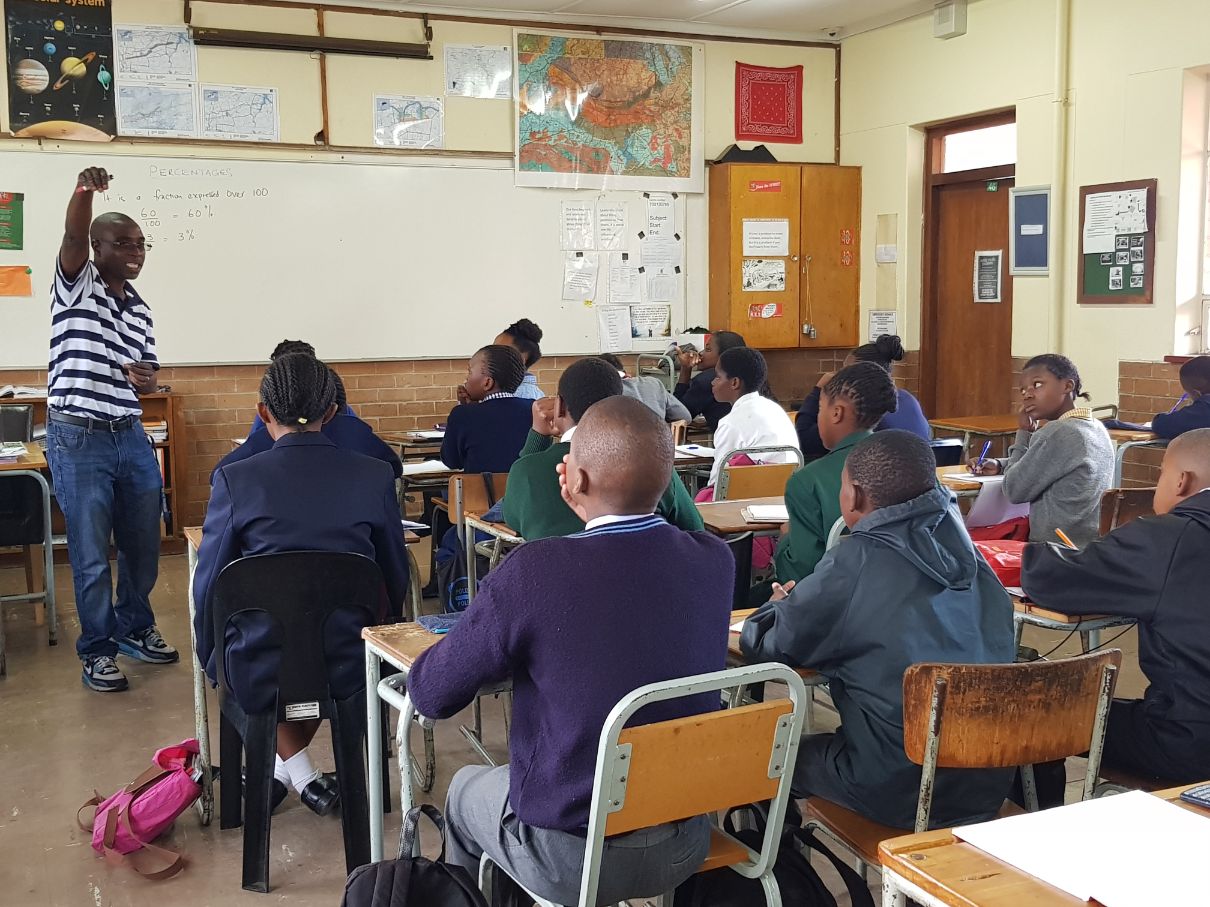
Now in Grade 10, Luyolo has been with the programme since the start of his school career and says the holiday and Saturday classes offered have given him the edge at his place of learning.

“I am very interested in programming and coding and I also enjoy physical science. I think what the Tomorrow Trust has helped me most with is my confidence in these subjects,” he says.

“The classes have helped me improve my school marks. Actually, because of the programme I find myself two steps ahead of others in my class.”

Luyolo is not alone in his praise for the Saturday school and holiday programme, which is geared towards building and strengthening English, Maths, Life Sciences and Physical Sciences.

Tembisa High School learner Sandile Vilakazi, 16, has been with the Tomorrow Trust since the age of seven.

“They (trust) are helping us build a better future for ourselves,” Sandile says.

“They have really helped me a lot and I find that I am doing well at school. They are very kind and patient with us, always making sure we understand the work.”

Sandile, who is especially interested in robotics, aims to study at the University of Cape Town on completion of his schooling.

Another learner who says he has a “better chance” of carving out a career in IT because of the programmes support is Njabulo Kubheka, 16, of Inqayizivele Secondary School.

Like Luyolo and Sandile, he joined the trust’s programme from a young age.

“The classes make you think outside the box, and the facilitators are very patient. You can always ask questions to make sure you understand the work properly,” he says.

“I am sure without these classes I would not do as well at school. I don’t mind doing the work at all. It’s really helping me to one day get into the University of Cape Town, which is my dream.”

Entities like the Tomorrow Trust are vital if South Africa’s less privileged learners are to rise above their circumstances and prosper one day. For every 100 South African learners, only 51 make it to matric, while only 40 finish high school, 16 qualify for tertiary study and just two will graduate university or college.

The Trust is determined to break the cycle through its learning programmes and holistic approach. Not only does their subject performance improve, but learners are also required to give back to younger students and to their community. As communities become more educated, economies thrive, jobs increase and poverty rates decline.

The Tomorrow Trust receives its own support from the Datatec Educational and Technology Foundation, which has also recognised the importance of investing in maths and science programmes in townships to produce outstanding graduates who will not only take the country forward, but also uplift their own communities.

“Our vision for South Africa is perfectly aligned with that of the Tomorrow Trust,” says Datatec Foundation chair Maya Makanjee.

“In order for us to grow as a nation, it is imperative that no child is left behind, regardless of their background and upbringing. Our commitment to improving performances in the STEM (Science, Technology, Engineering and Maths) subjects is because we believe these are key to unlocking prosperity for all South Africans.”

Word Count: 634

About Datatec Educational and Technology Foundation

Datatec, a Johannesburg-based multinational information and communications technology (ICT) solutions and services group, is a company with a heart. Recognising that education is the base on which a successful economy is built, the company funds educational organisations serving underprivileged communities across the country through its Datatec Educational and Technology Foundation. In this way, Datatec gives back to the country and the economy that fostered its initial growth.

For more information, please contact:

Sam Logan

021-418-2466

060-779-5359

sam@transformmarketing.co.za

EDUCATION-SPECIFIC VR HEADSET FOR STEM SUBJECTS

The headset contains Veative’s full educational content library within the all-in-one EduPro headset. Does not require a computer or connectivity

Sangari Education, distributor of the Veative virtual reality (VR) library of STEM-related content, has launched the Veative Edupro headset specifically for educational use.

“While the Veative content can be used on many popular headsets, the EduPro provides a more cost effective and user friendly headset. Veative has developed a large library of STEM-related content of 543 modules, which have been mapped to the South African Curriculum for Maths and Science grades 7 to 12,” explained Sangari Education MD, Bez Sangari.

“The EduPro headset, being specific to educational applications, introduces enhanced features over competitive products that don’t focus specifically on educational applications.”

“This full content library resides on the all-in-one EduPro headset which does not require a computer or connectivity, making it easy to use.”

“For those schools who would like to give their teachers and students the opportunity to develop their own content, Veative has produced a VRcreate software which makes content development easy and accessible to all,” Mr Sangari added.

He explained that the Veative EduPro is the world’s first XR1 chip-enabled mobile VR device designed specifically for educational use. “The preloaded Veative VR content library within the headset provides convenience and removes the need to load and unload modules manually.”

The VR headset has 128Gb of internal storage, sufficient space for Veative’s entire library and for additional content. “The operating system is built for education, and there are no social media or privacy concerns or distracting applications,” Mr Sangari said.

The headset includes a built-in Mobile Device Management (MDM) feature and has a MicroSD card slot for further expansion, an Integrated touchpad, and handheld Bluetooth controller.

About Sangari Education

Sangari Education has a clear vision of what it aims to achieve as an Education Solutions company focusing on Industry 4.0. Sangari is eager to inspire clients with support and training to achieve their full potential. Sangari subscribes to the viewpoint that there is a direct correlation between education and decent jobs. Our philosophy is to apply sound business principles, and together with modern technology we help our clients establish and maintain a modern and efficient education system and in every instance producing measurable results. Our teaching philosophy is founded on augmenting teachers’ skills and making learning exciting for students. Sangari incorporates a blended learning approach that integrates theory with practical experience, creating the ideal teaching and learning environment.

Veative history and Philosophy

Starting out in 2016, we were determined to create a VR learning experience based around these key assumptions: 

·        We would focus on one core topic or concept at a time 

·        We write and develop around curriculum standards 

·        We tackle abstract or conceptually difficult concepts first (for students) 

·        We have assessments within the environment to ensure that teachers are connected with the learning, without needing to hover, monitor, or babysit 

·        All content should be available online and offline (no network dependency) 

·        It should be localizable for different regions and languages

·        It should be cost effective, ensuring no one is left behind 

From the start, we choose to be device-agnostic, hoping to leave the VR hardware decision to schools and districts. We wanted to make our content for all devices. However, the reality of the market created problems, not just for us, but for everyone. From small storage sizes on devices (meaning the content cannot be used offline), to dropped controller signals in larger classrooms, we lived through it all on the hardware side. We learnt quickly that devices made for gaming and entertainment are NOT education-focused, nor education-ready. As educators in this market, we need to be concerned about privacy and security issues, management of content (so that it is easy, and not even a concern, for teachers), a breadth of content (ensuring every student, in every class we have content for has meaningful things to learn and interact with), and proper thought toward the experience of students, teachers, IT and admin. Gaming and entertainment devices have NO thought toward any of these issues. So, to address the needs of schools and districts everywhere, we designed the EduPro VR headset, a device purposefully built specifically for education.

SABC 2 HERITAGE DIGITAL COMPETITION

  1. ENTRY: Participants of this competition are required to read and fully understand the terms & conditions of entry on Facebook.
  2. The competition will run from Tuesday, 20 September 2022 to Tuesday, 27 September 2022.
  3. The competition is open to all South African citizens except directors, members, partners, employees, agents, service providers, and any SABC employee including agencies, and/or their spouses, life partners, parents, children, brothers, sisters, business partners, or associates.
  4. Winners will get the following:
    a. SABC 2 Hamper
  5. Winners will be contacted by the SABC to verify the following: name, surname, ID number, and address.
  6. Winners, who are not contactable by phone, after the closing date/time, will be disqualified and a new winner will be drawn.
  7. The SABC and its agents accept no responsibility for any problems or technical malfunction of any communication network or any late, lost, incomplete, misdirected, incorrectly submitted, delayed, illegible, or corrupted entries. The SABC and its agents are not liable for any costs incurred, responses received, or any other consequences of user error.
  8. The judges’ decision is final and no correspondence will be entered into. The SABC or its agents will not be held responsible for any disputes arising from the competition or prize awards.
  9. Prizes are non-transferable, and cannot be deferred or exchanged.
  10. Winners use prizes at their own risk. The SABC and its agents shall not be liable for any loss (including, without limitation, indirect or consequential loss), damage, personal injury, or death that is suffered or sustained (including but not limited to that arising from any person’s negligence) in connection with this competition or accepting or using the prize/s.
  11. Entrants will be deemed to have accepted these rules and agree to be bound by them when entering.
  12. Winners will be selected from a random list of correct entries.
  13. The prizes will all be couriered to all the winners by end of the competition.
  14. If an entrant contravenes these rules, the entrant may at the discretion of the SABC be disqualified from the competition.
  15. Entering this competition line indicates acceptance of all the above rules.

AUGMENTED-REALITY GEARS UP FOR EDUCATION 4.0 AND REDUCES TRAINING COSTS

Unemployment in South Africa is at its highest ever, this can be blamed on the global economic downturn and Covid19 and other local factors, however, we must be positioning our industry for the recovery which will inevitably ensue. In order to be ready for the IR4.0 job market, training is essential. The machinery and specially consumables for welding training are expensive, and providing theory with little or no practical training is usually insufficient.

“In addressing IR4.0 in the engineering and manufacturing markets, augmented-reality welding training is a cost-effective as well as a Green alternative to traditional training. It provides the same level of traditional skills training but offers significant cost savings that can run into millions of rands per annum. This is an example of IR4.0 in action for Education,” said Bez Sangari, CEO, of Sangari Education.

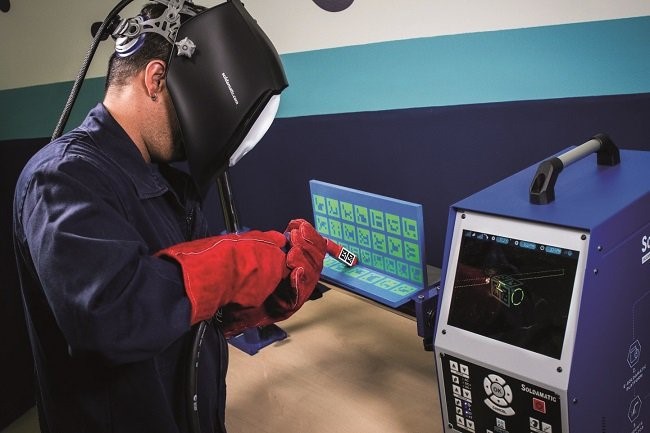
The Soldamatic welding simulator, which has won top honours at the Worlddidac Awards for the most innovative educational product, requires no costly welding consumables and reduces training time by half.

A number of organisations have installed the Soldamatic for upskilling trainee welders. Over the last 10 years, numerous TVET Colleges and industrial training centres have also chosen Soldamatic as their preferred welding training Solution.

“The welding training can be done in any environment and is 100% safe, simply because it is an augmented welding environment and there are no gas emissions,” Mr Sangari said.

“As we move into the 4th Industrial Revolution there is a need for training providers to modernise and equip themselves with changes taking place in the industries. The Soldamatic welding simulator offers training officers and learners the opportunity to constantly upscale their capabilities without the costs associated with such activities.”

“The reason most organisations choose the Soldamatic is based on the cost compared to traditional, non-simulation products, on the market, and the software is continually being updated with additional functionality.”

“Cost-saving benefits include less electricity consumption, less material wastage, and depending on the learner numbers, the classroom serves as a safe, environmentally-friendly workshop.”

Mr Sangari added, “Consumables such as welding rods, steel plates, or oxygen are not needed, and because the equipment has no gas emissions, it is eco-friendly. The simulator can be used in any environment with no need for special clothing or ventilation. The welding can be done in a classroom or even an office. It is 100% safe, simply because it provides an augmented-reality welding environment which is hyper-realistic.”

“The training solution is based on hardware and software which are an augmented-reality 3-D vision on the trainee welder’s headgear and real welding torches, and the software is a learner management system (LMS) which will allow trainees to follow a predetermined training program and provide feedback to the trainer on their progress.”

Payback for a large training institution is about 18-24 months. The quick payback period is achieved as no consumables are used and there is no wastage of materials. Also, training can continue without the full supervision of the lecturer which means more practice time for the trainee.

The headgear generates hyper-realistic welding graphics and sound such as the weld pool and beam. It emits simulated smoke, sparks, and heating of the affected area, all through the student’s headgear. It also simulates cracks, filler material, gravity, and undercutting.

Welding skills can be learnt for specific applications and the student’s performance measured in a fair, reliable, and unbiased manner. The unit includes 93 different training lessons and customised lessons can also be added.

The facilitator and trainee are able to analyse and assess the trainee’s welding performance in a video afterward and evaluate their skills levels such as the welding velocity, stick-out, travel, and working angles. The system will report on each student’s progress and retains a detailed portfolio of their learning progress.

THE SABC MOURNS THE PASSING OF LUMKO JOHNSON LEQELA      

Johannesburg, 15 September 2022 – It is with great sadness that the South African Broadcasting Corporation (SABC) has learnt of the untimely passing of former YoTV presenter and content producer, Lumko Johnson Leqela who passed away on Wednesday 14 September 2022.
Lumko was dynamic and passionate about human rights issues and storytelling.
The SABC sends its heartfelt condolences to their family, friends, and colleagues.

May their soul rest in peace.

THE EXPRESSO MORNING SHOW ON AIR COMPETITION  

  1. ENTRY: Participants of this competition are required to read and fully understand the terms & conditions of entry on www.sabc.co.za  
  1. The competition will run from Monday 22nd  August 2022 to Saturday 27th  August 2022. 
  1. The competition is open to all South African TV viewers  
  1. SMS the key word ‘Expresso’ followed by your name and the correct answer to 33376 
  1. The competition is open to all South African citizens except directors, members, partners, employees, agents, service providers, and any SABC employee including agencies, and/or their spouses, life partners, parents, children, brothers, sisters, business partners or associates. 
  1. Competition winners will get the following: 
  1. A chance to watch The Expresso Morning Show broadcast live, at the Cape Town studios (the prize does not include travel and accommodation) and attend the Expresso PR photoshoot  
  1. Friday, 2 September 2022 
  1. S3 and The Expresso Morning Show branded merchandise 
  1. A premium rate of R1.50 will be charged for each SMS entry for the on-air and digital competition. 
  1. Entrants under the age of 18 are not permitted. Entrants should be 18 years and older.  
  1. Winners will be contacted by the SABC to verify the following: name, surname, ID number, and address.  
  1. Winners, who are not contactable by phone, after the closing date/time, will be disqualified and a new winner will be drawn. 
  1. The SABC and its agents accept no responsibility for any problems or technical malfunction of any communication network or any late, lost, incomplete, misdirected, incorrectly submitted, delayed, illegible or corrupted entries. The SABC and its agents are not liable for any costs incurred, responses received or any other consequences of user error. 
  1. The judges’ decision is final, and no correspondence will be entered into. The SABC or its agents will not be held responsible for any disputes arising from the competition or prize awards. 
  1. Prizes are non-transferable and cannot be deferred or exchanged.  
  1. Winners use prizes at own risk. The SABC and its agents shall not be liable for any loss (including, without limitation, indirect or consequential loss), damage, personal injury or death which is suffered or sustained (including but not limited to that arising from any person’s negligence) in connection with this competition or accepting or using the prize/s. 
  1. Entrants will be deemed to have accepted these rules and agree to be bound by them when entering. 
  1. Winners will be selected from a random list of entries. 
  1. If a random winner is drawn from a list of cellular phone numbers, the owner of the SIM card will be deemed the winner, even though the handset may have been used by another individual to enter the competition. 
  1. If an entrant contravenes these rules, the entrant may at the discretion of the SABC be disqualified from the competition. 
  1. Entering this competition line indicates acceptance of all the above rules 

AFTERNOON EXPRESS SHOW ON AIR COMPETITION  

  1. ENTRY: Participants of this competition are required to read and fully understand the terms & conditions of entry on SABC website: www.sabc.co.za   
  1. The competition will run from Monday 22nd August 2022 to Saturday 27th August 2022. 
  1. The competition is open to all South African TV viewers  
  1. SMS the key word ‘Afternoon Express’ followed by your name and the correct answer to 33376 
  1. The competition is open to all South African citizens except directors, members, partners, employees, agents, service providers and any SABC employee including agencies, and/or their spouses, life partners, parents, children, brothers, sisters, business partners or associates. 
  1. Competition winners will get the following: 
  1. S3 and Afternoon Express branded merchandise 
  1. Attend the behind the scenes of the photoshoot for Afternoon Express (Travel and Accommodation is not included in the prize) 
  1. A premium rate of R1.50 will be charged for each SMS entry for the on air. 
  1. Winners will be contacted by the SABC to verify the following: name, surname, ID number and address.  
  1. Winners, who are not contactable by phone, after the closing date/time, will be disqualified and a new winner will be drawn. 
  1. Entrants below the age of 18 years are not permitted and should be 18 years and above. 
  1. The SABC and its agents accept no responsibility for any problems or technical malfunction of any communication network or any late, lost, incomplete, misdirected, incorrectly submitted, delayed, illegible or corrupted entries. The SABC and its agents are not liable for any costs incurred, responses received or any other consequences of user error. 
  1. The judges’ decision is final and no correspondence will be entered into. The SABC or its agents will not be held responsible for any disputes arising from the competition or prize awards. 
  1. Prizes are non-transferable and cannot be deferred or exchanged.  
  1. Winners use prizes at own risk. The SABC and its agents shall not be liable for any loss (including, without limitation, indirect or consequential loss), damage, personal injury or death which is suffered or sustained (including but not limited to that arising from any person’s negligence) in connection with this competition or accepting or using the prize/s. 
  1. Entrants will be deemed to have accepted these rules and agree to be bound by them when entering. 
  1. Winners will be selected from a random list of entries. 
  1. If a random winner is drawn from a list of cellular phone numbers, the owner of the SIM card will be deemed the winner, even though the handset may have been used by another individual to enter the competition. 
  1. If an entrant contravenes these rules, the entrant may at the discretion of the SABC be disqualified from the competition. 
  1. Entering this competition line indicates acceptance of all the above rules 

Nthabiseng Kgosana

Nthabiseng Kgosana grew in Alexandra Township, but is originally from Vaalbank, In Mpumalanga. She attended Minerva High School where she was crowned 2nd princess in 2004 and 1st princess in 2005 in the Miss Minerva High School pageant. After high school, she obtained her qualification in BCOM Accounting at UJ.

Her first production that she was ever part of was being part of the AFDA final year student project in 2017 where she was headhunted by an agent. The second one was a short film called ‘Boshego’ with Worthy Film Productions in 2017.

When asked why she chose acting, she said, “I believe that acting chose me. Since pre-school, I was always one of the pupils chosen for plays. I’ve been in instances where I would accompany a friend to a certain community hall and end up being part of the actors. I remember back in high school in grade 8 I was looking for my friends, I accidentally opened a class where senior students were practicing drama – on that very same day of watching them practice, I joined and I impressed the guys who were directing the drama. Also unlike the corporate world that drains me in various aspects, I’ve realised that I love working in the entertainment industry because every time I leave the studio I enthusiastically look forward to the next day.”

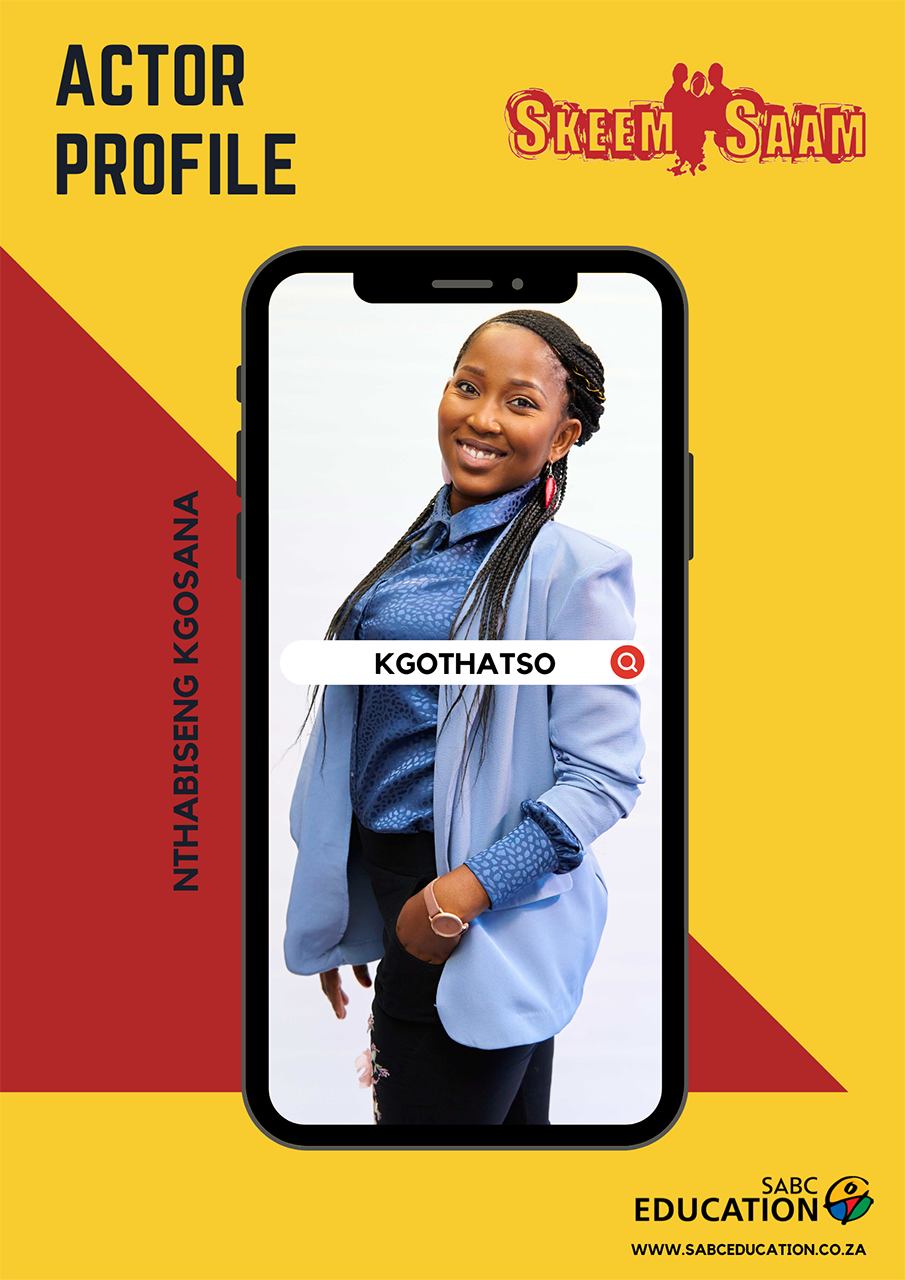
Her 3rd and biggest production is Skeem Saam. Where she played the role of ‘Kgothatso’, Leshole’s girlfriend. An appealing woman that has good fashion sense and is dedicated to her job and her daughter. She is well-spoken and confident. Her desire was always to one day settle with a good man and although she had her doubts at first, she eventually believed that Leshole was that guy.

#SkeemSaam airs every weeknight on SABC 1 at 18.30pm

SA a Leading Region in Pre-COVID Online Learning

Research covering higher education (HE) instructors’ priorities and challenges in course delivery conducted by education technology company Cengage EMEA indicates that prior to COVID, South Africa had the highest percentage of learners receiving online or blended learning as their main mode of course delivery compared with the UK, Middle East and Europe.

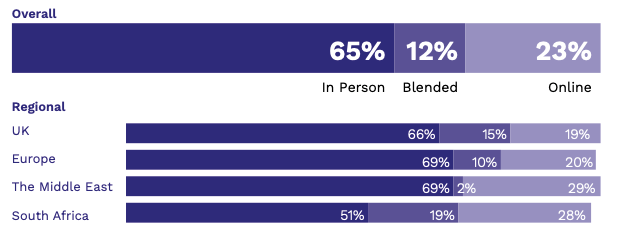
South Africa had a pre-COVID online and blended learning course delivery of 47% compared with the UK at 34%, the Middle East at 31%, and Europe at 30%.

The survey covering 402 HE instructors indicated South Africa having the lowest percentage of In-Person learning at 51% followed by the UK (66%), Europe (69%), and the Middle East (69%) prior to COVID.

Overall, two-thirds of the higher education instructors were delivering their course content in-person pre-COVID, with just a quarter predominantly delivering their course content online.

The results may indicate that SA was moving at a faster pace towards online learning prior to COVID. Another factor could be that in SA, courses are generally much larger, some with thousands taking a course, and therefore online would be better suited for managing very large cohorts.

Segment membership
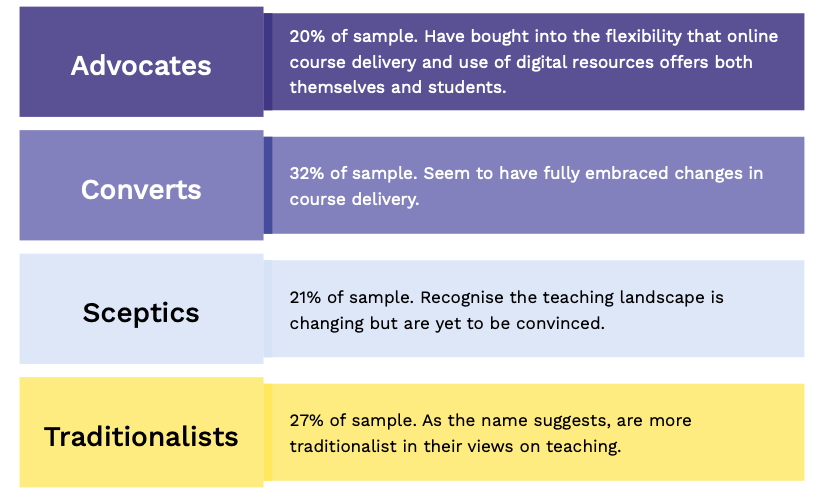
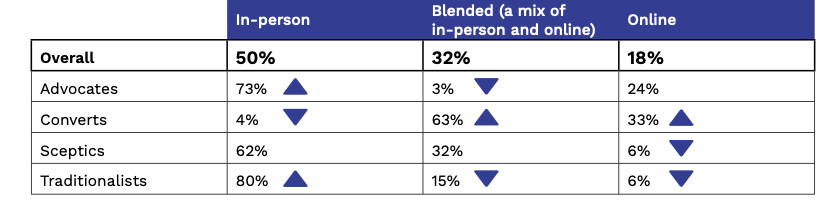
In the research, Cengage EMEA identified four core instructor segments that the company says go some way to distinguishing attitudes to the use and future use of digital content and delivery in higher education settings. Cengage has called these segments: Advocates, Converts, Sceptics and Traditionalists. The largest group of instructors were designated as ‘converts’ and the second largest group ‘traditionalists’. Each segment shared particular characteristics, as seen below:

Resources Used

Also prior to COVID, it was found that a combination of resources to deliver courses was used, with basic digital resources such as eTextbooks, instructor PowerPoints, and instructor notes, being part of this and used by 77% of the overall sample.

In combination with these basic digital resources, instructors representing half the sample were typically using ‘reading from print textbooks’, ‘lecture notes’, ‘practice questions’, and ‘practical sessions’, alongside journal articles. Journal articles were significantly more likely to be used in the UK (62%) compared to other regions, whilst the UK was also significantly more likely to use published materials (63%) and recorded lectures (38%).

TEACHING PREFERENCES
By the time the study was carried out, COVID-19 had disrupted teaching in most higher education institutions (HEIs) for over a year, forcing many to move their teaching online. The sample was asked: Thinking about your own teaching preferences, how would you prefer to teach your course?

Overall, HE instructors showed a preference for either in-person or a blended mix of online and face-to-face teaching. However, preference differences were noted across the segments, with ‘advocates’ showing a significantly greater preference for in-person teaching and lower for blended.

‘Converts’ showed a significantly higher preference for a blended or online approach to course delivery, whilst ‘traditionalists’ evidenced significantly higher preferences for in-person teaching and much lower preferences for blended or online teaching, suggesting that they are more rigid in their in-person preferences. ‘Sceptics’ showed a lower preference for online only.

Thinking about your own teaching preferences, how would you prefer to teach a course?

Regionally, European instructors showed a significantly greater preference for in-person teaching (62%), whereas those in South Africa show a significantly lower preference for in-person teaching (31%).

Core reasons for preferences:

In-person

  • preferred interaction and contact
  • can see if students understand the course I’m teaching
  • it’s easier to demonstrate something

Blended

  • provides flexibility for students
  • some aspects need in person interaction

Online

  • provides flexibility for students
  • flexibility for me to teach around family and personal commitments

THE REALITY OF DELIVERING COURSES USING DIGITAL CONTENT

Understandably, the enforced move for HE institutions to deliver teaching online to their students over the course of the pandemic met with a range of responses. Through the study, Cengage EMEA says it wanted to gauge the perceived benefits and challenges of using digital content to deliver teaching so that education providers and content providers, It can work together to further improve any future experience of this for educators and students alike.

Perceived benefits

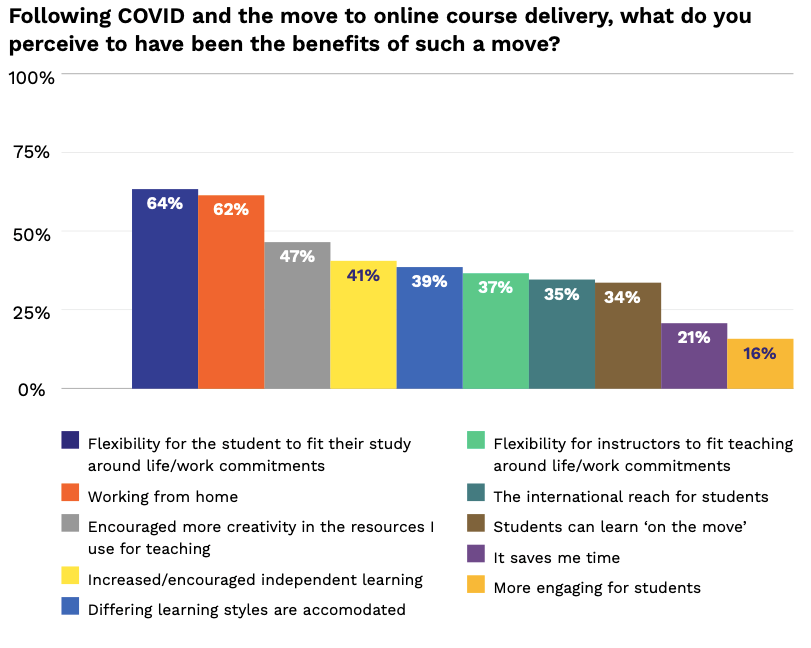
The sample highlighted many perceived benefits in making the transition to online course delivery. The main benefits of online course delivery highlighted by instructors included:

  • flexibility for students (64%)
  • instructors being able to work from home (62%)
  • encouraging more creativity in resources used by instructors (47%)
  • increasing independent learning (41%).

Following COVID and the move to online course delivery, what do you perceive to have been the benefits of such a move?

Unsurprisingly, the ‘converts’ segment were most likely to perceive a fuller range of benefits than other segments, whilst also noting additional benefits of embracing online course delivery such as accommodating different learning styles, the flexibility for instructors to fit teaching around life-and-work commitments and allowing students to ‘learn on the move’. ‘Traditionalists’ were more likely to perceive fewer benefits of an online mode of teaching.

Perceived drawbacks

When asked about the perceived drawbacks of online course delivery, the most commonly cited drawback will be recognisable to anyone that endured lockdown in some form. Just over a fifth (21%) claimed that the core drawback was the students missing social interaction.

However, they also cited the difficulty in assessing student understanding, which is something that some digital solutions can aid educators with. It is notable that ‘sceptics’ tend to express more drawbacks with online course delivery than the other segments and were more concerned about assessing student understanding and engagement, which, again, digital solutions can offer assistance with.

Across the regions, there was a little discrepancy, with the exception of Africa where ‘broadband issues’ was the key concern for a third of instructors, as well as the perception that students find the use of technology stressful. It is likely that these two issues are related.

Potential concerns

Some wariness to moving courses online, particularly at short notice, is understandable. To gauge this the sample was asked: During COVID, which of the following potential concerns, if any, have you had about delivering online courses?

The main concerns expressed were around students’ motivation and engagement, but also instructors had concerns around their own ability to deliver certain aspects and having to potentially rewrite course content, which is presumably a time issue.

Meeting expectations

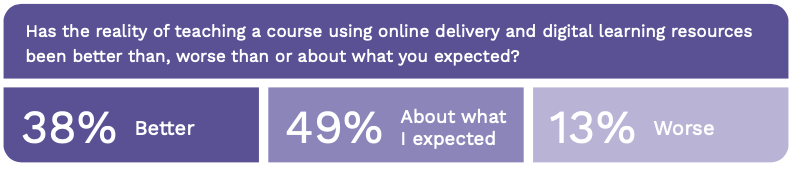
That said when asked about the reality of teaching a course using online delivery and resources the experience for just under half of the instructors predominantly met expectations. Whilst almost 4 in 10 agreed that teaching a course using online delivery and digital learning resources was a better experience than they had anticipated.

For those that stated that the experience of teaching a course using online delivery and digital learning resources was better than expected, the reasons given included:

  • Students actively engage online / better student engagement (15%)
  • Flexibility for students / teachers (9%)
  • Students/teachers adapted well (7%)
  • The technology worked well (7%)

Although no differences were observed by region, there were differences noted by segment.

‘Sceptics’ significantly more strongly felt that the experience had been worse than they expected (43%), whereas ‘advocates’ and ‘converts’ believed it to be a better experience.

Those who had expressed greater confidence in delivering digital content had a more positive experience (43%), which suggests that familiarity with digital content is beneficial. Where expectations were not exceeded, this is mainly due to initial concerns being realised, lower student engagement; time consuming etc.

This seems to reinforce the view that the more practiced and confident educators are with using digital learning resources, the better their experience and the more likely they are to notice the benefits of using such resources.

So, where does this leave instructors? Online learning is now increasingly important and impactful to the improvement of the teaching and learning experience. To realise the full potential of technology-enhanced learning, help, and support for instructors to develop digital and pedagogical tools to teach effectively both in remote and in-person settings is an imperative factor in course delivery in higher education.